
What follows here has got to be one of my all-time favorite business stories – that of my friend John Hancock, a long-time internet entrepreneur, who recently bootstrapped a concrete company with $50 in startup capital, and sold it less than five months later for three million dollars.
If you know me personally, you know I haven’t stopped talking about this since the deal officially happened back in July, and as I sit here putting the finishing touches on this profile, I think I see what I liked about the story so much…
It’s not just the numbers (though those would be impressive for any business owner).
It’s the fact that so much of this was so unexpected. John started this project as a test to see if it was possible for someone in tech to replace their income by working part time, on the side, in the trades. He had no experience there, and no contacts. Just curiosity coupled with the willingness to take little steps when most people pause.
I’ll let you judge for yourself how it turned out.
Then, there is also the timeliness. Right as AI is reshaping everything, a question has started to circulate throughout the tech community: “Is my livelihood safe? And if not, what the hell should I be doing about it?”
As you’ll see, John’s been thinking about that very question for almost a decade now – since long before most people ever thought it’d be an issue.
To understand why (and how it led to him bleeding in his driveway with three strangers) let me first take you back in time…
The Story Begins In The Fall Of 2020…
Hancock and his then-business partner had just launched a brand new media company called Stonks, which started off as an irreverent take on stock market news, and grew into a massive startup funding platform that helped founders raise well over $100m via virtual demo days.
Early on, you might not have guessed what it was headed for though.
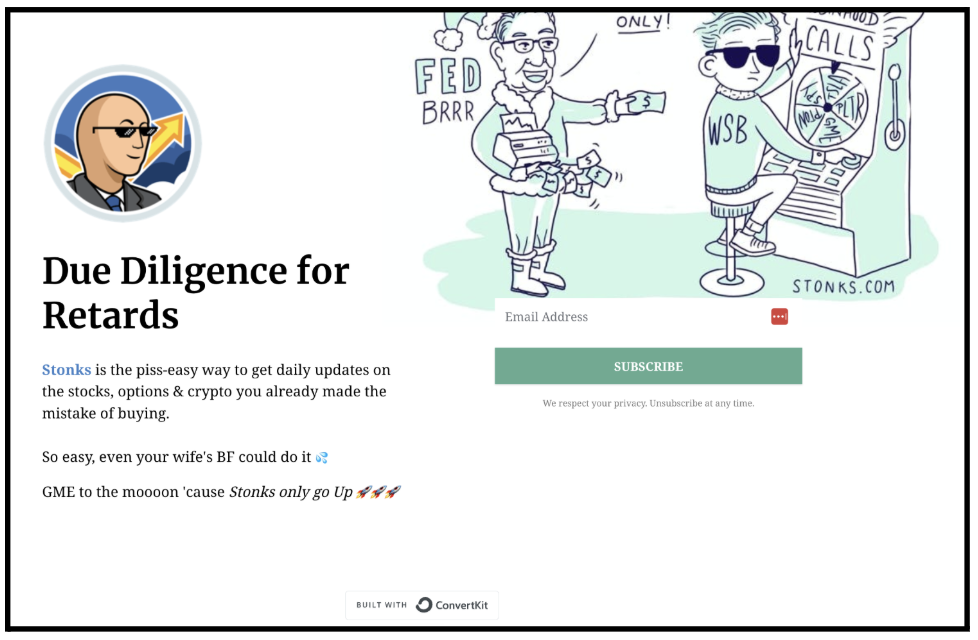
Inspired by the burgeoning Wall Street Bets community, which won global attention in 2021 for the role they played in the GameStop short squeeze, Stonks leaned into the aggressive, fast-paced, self-deprecating humor of the times. “So easy, even your wife’s boyfriend could do it,” went the common tagline.
“It was just the most vulgar, upsetting [thing],” he chuckled in our interview. “I don’t know why. If you look at the Internet Archive, and you go back to December 2020, it’ll say in 120-point font, ‘Due Diligence for Retards.’ Like, that was our brand.”
Anyone who reads that and finds themselves reflexively clutching for their pearls can take heart in knowing that John was, in fact, mis-remembering. For I checked the internet archive, and the headline he mentioned doesn’t appear there until January of 2021 (and even then, it’s in a very modest size thirty-three font).
No, at the end of 2020, Stonks’ homepage was a much more buttoned-down video of Dave Portnoy in a tank top, yelling at CNBC’s Ron Insana, and pulling random scrabble tiles out of a bag in order to pick stock tickers.
Still, you get the picture – Stonks was a wildcard.
And their voice wasn’t the only unique thing about them. John and his co-founder were years ahead of the rest of the media industry on something that’d change the world.
“There was this new insane technology which nobody was really using yet called speech transformers,” he told me.
Transformers are a form of deep learning architecture used to develop some LLMs. In fact, they are the ‘T’ in “GPT.”
Speech transformers deal particularly with spoken language (e.g., transcribing earnings calls), and very few media companies were experimenting seriously with them or any other AI tools back then. But Stonks was, and they hit on a use that ended up being a nice growth hack: Customization.
At the time, they had about 2,500 newsletter subscribers, and using AI, they made sure each person got something in their email that was unique from everybody else’s. People would tweet screenshots comparing witty lines, and it drove a bunch of engagement and visibility, all from content that wasn’t human-written.
“I remember seeing that and thinking, ‘I wonder if copywriters are in trouble,’” John said.
Now, because it’s been approximately six-hundred years since 2020, you’ve probably lost sight of just how far ahead of the curve he was on this particular insight.
Allow me to remind you: This was still two full years before the release of ChatGPT. Stonks would have been one of less than three-hundred projects in the world actively using GPT-3’s API to generate output. And that output would have appeared far from threatening to most human writers.
In fact, I have some personal experience with this.
Around the very same time, I too had early access to GPT-3 via the company I was writing for, and as an experiment, I fed it the first few lines of Melville’s Moby Dick, just to see what it’d do.
What it did was write one or two paragraphs of hauntingly beautiful prose about the freedom of a life at sea, before careening off onto an insane tirade about how whales are like Holland cheeses.
Simply put, the technology was barely capable of stringing together human-ish writing.
So John was definitely early.
But that question – about how AI would affect job security in the tech industry – stuck with him.
It was the lead domino that tipped off a series of events that followed him through each of his projects over the coming years, and was, in its own way, the genesis for the concrete company as well as what came after.

Stonks continued to be on the leading edge of AI use in the early 2020s. As capabilities grew, John foresaw more and more white collar jobs being disrupted and reshaped.
“This was before it could code,” he said. “Very early days. But even then, I thought it might evolve to a point where the typical tech founder could just be non-technical.”
So he started a newsletter called Founders Only, and wrote about what he was seeing, both as a founder himself, and also, someone who was helping other founders raise millions on a regular basis.
“Slowly, over time, I started writing more and more content about what’s going to happen if you just keep being a startup founder and you don’t actually have a way to future-proof your income,” he said. “It started to occupy my thoughts quite a bit.”
He Exited Stonks In 2024
By that point, AI was the main thing on his mind. He spent a year or so taking odd consulting jobs, but through it all, the issue of AI displacement kept coming back to him, and much of the work he found himself doing involved teaching companies, if not how to fully replace people with AI, at the very least, how to avoid hiring more of them.
As ‘25 gave way to ‘26 two things happened that changed the course of his life significantly.
First, he and his friend, Ron, started working on a new business – they were looking for something future-proof.
“We’d ask, ‘What’s going to be left in five years,’ and we would think, ‘Okay, well, people are still going to buy stuff,’” he said.
“And we’re like, ‘Okay, well, do we want to do a store? No. We like software.’ So we thought, ‘What if we build an app that helps facilitate the purchase of physical goods?’”
Prior to Stonks, John had built a few successful ecommerce brands.
In one of them, he ran a playbook where he had a small team of people whose sole job was to email shoppers who’d abandoned their carts, chat with them as though they were him, and offer them bespoke deals (directly from the “founder”) that got them to buy.
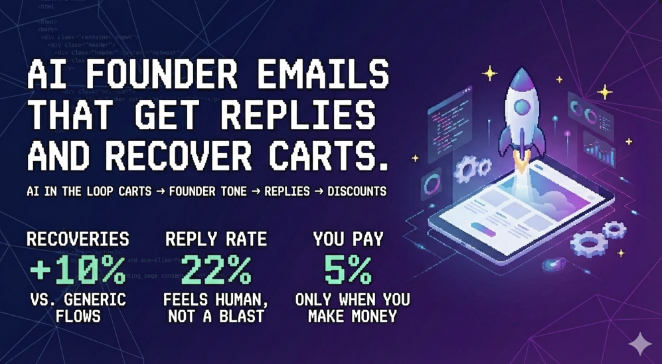
AI chatbots now made it possible to run the same sequence at scale, automatically, so he and Ron got to work building software to do exactly that. They called it Stanly, and the early signs were promising.
“It looked really good,” he said. “We were signing on new stores all the time. I thought it was definitely going to work. Then I had this fucking conversation…”
The conversation was with a reader from his newsletter. Still obsessed with the question of how to future-proof your income, he’d put the word out to readers that he was thinking of starting a podcast, and people should reply if they wanted to be on an episode.
Dozens of responses came back, but one caught his eye in particular:
“This is probably not what you’re looking for,” it read, “but I recently started a concrete company, and we’re doing pretty well.”
The note came from Jeff Price, an entrepreneur based in Houston.
Jeff, who’s been public about his numbers, was a former software developer who started Texas Slab Guys in 2025. By the time he talked to John earlier this year, things were off to a good start, and as of this writing, he was on-track for $2m in 2026 revenue just a little over a year after starting.
“I was like, ‘Him first,’” John told me. “I’ve gotta talk to him right away.”
The conversation went well – you can actually watch it here – and by the end, John felt an inescapable urge to try this business.
“It was just the most future-proof thing I could imagine,” he said. “If you were to make a list of the most future-proof things ever – something that the Optimus robot isn’t going to do anytime soon – it was this.”
I think there was something else too. Something you might not spot if you didn’t know what you were looking for.
In a career spent talking to founders, John is one of the better salesmen I’ve ever bumped into. Most people don’t notice it at first (probably part of why he’s so good at selling).
But he has built five other million dollar companies. He’s spent ten years teaching a sales framework he designed to teams around the world. In fact, he has a lifetime 50% discount on Enterprise car rentals because he once taught that framework to a VP at Berkshire Hathaway, who went on to teach it to 1,500 employees and gave him the discount as a personal thank-you.
So while he didn’t necessarily come right out and say this, my bet is that the moment he got a look at the world of blue-collar trades, he (rightly) realized he could sell circles around anyone else competing there.
“I remember thinking, ‘I’m going to knock this out of the park.’” he told me in our interview.
He asked for Price’s blessing, and got it.
“He said, ‘You’re in Austin. I’m in Houston. Go for it. But you should know it’s not a good business in Austin.” Price was doing something called “concrete leveling,” which is a specific type of concrete work, much more commonly needed in Houston’s sub-tropical marshland than it is on the rugged stone escarpment that lies beneath Austin.
That was not enough to dissuade him.
So all that was left was to go to his business partner, Ron – currently several months into a software build that looked like it was going to be a raging success – and convince him to change course entirely.
“I said, ‘Let’s be real, Ron – in five years, every store in the world is going to be able to speak this app into existence with Claude, right? So, have we done anything truly future-proof, or have we just built another thing that’ll be replaced?’”
There was a bigger vision too. John wanted to teach tech people how to future-proof their income, which meant he needed to build something other people could replicate. If he and Ron got the concrete business to work, he bet they could teach others how to do that or other trades.
But people would only listen if they could prove the model themselves. So they set their sites on $200k in profit – enough to replace a mid-level tech salary – and agreed to limit themselves to part-time work in the beginning.
“He was like, ‘Okay, let’s do it,’” John told me. “So we stopped working on Stanly and instantly within one day we’re working on concrete.”
Tech Guys Get Into The Concrete Business
There is a certain perfect kind of irony in what happened next. In their quest to break into an industry that AI hadn’t made obsolete, John and his co-founder used AI to do… well… almost everything.
That first night, they sat in a Slack huddle, pinging ChatGPT with questions.
They asked what they should call the business, and one of the options that came back – Hill Country Slabs – sounded like the right fit.
The domain was available, so they bought it, then had Chat make a logo, design a landing page, write the bio for their Facebook page, and sketch out options for their first Meta ads.
Within a day of his conversation with Jeff Price, they were live, running ads, with a $50/day budget.
What’s fascinating here is the speed-to-execution. You hear about entrepreneurs being quick to act, but to see what that actually looks like for someone who’s working on their sixth company – the cycle time is just so much shorter than most people expect.
“We had eight leads on day one,” John told me, “and I was like, ‘Ron, this is a business, baby! Let’s sell. Let’s do what we do best.’”
Then he picked up the phone and started dialing.
At this point, you may pause to wonder what either of them knew about concrete?
The answer is: Almost nothing.
As John pointed out in our interview, he doesn’t own a house – he’s a perennial renter – so concrete and its maintenance had never even risen to the realm of his attention before that day.
The plan was to sell a job under the Hill Country Slabs brand, then sub-contract it out to another local concrete company, essentially capitalizing on John’s ability to market and sell, and taking a cut on the arbitrage.
“Yes, but don’t you need to know something about concrete in order to sell it?” I hear you wonder.
And here the answer is, “ChatGPT to the rescue again.”
“Of our first batch of leads, one of them became our first customer,” John told me. “I’ll never forget it.”
The man was actually a renter too. He had a condo with a patio, and a small 2’x5’ pad that had cracked and needed replacing.
John took the call on speaker-phone, so his hands were free to type.
He asked ChatGPT which questions he should ask in order to bid the job. The prospect talked, John relayed his answers to the AI, and in the end, Chat spit out three prices: $900 for a budget option, $1350 mid-range, and $1700 premium.
Not wanting to fly too close to the sun on their first sales call, he opted for the middle of the road quote.
“I tell him, ‘Yeah, it’d be about $1350,’” John said, “and he was like, ‘Okay, when can you come out?’ I said, ‘Let me call you back.’”
He hung up, and instantly started calling concrete companies, and that was just about the moment that it became painfully clear that ChatGPT also didn’t know how to price concrete jobs.
The first contractor who answered hung up almost instantly.
The second was more patient. He listened as John talked through the size of the pad, damage, etc, thought for a minute, and told him that his team would take the job, and it’d probably run around $2,000.
“I was like, ‘Can you do it for eight-hundred?’” John said. “And he was like, ‘Did you charge $800?’”
[Long pause] “Yes.”
The man sighed, said they’d do it, but that he was going to have to teach John how to price better if they were going to work together like this. From that point forward he became a kind of mentor – the first in a series of local contractors who were willing to take him in and teach him the trade.
This openness, and willingness to teach was one of the distinguishing characteristics about the trades that came up multiple times throughout the course of our chat.
“Everybody’s so nice,” he said. “And I mean everybody – they’re so cool, so nice, so down to earth.”
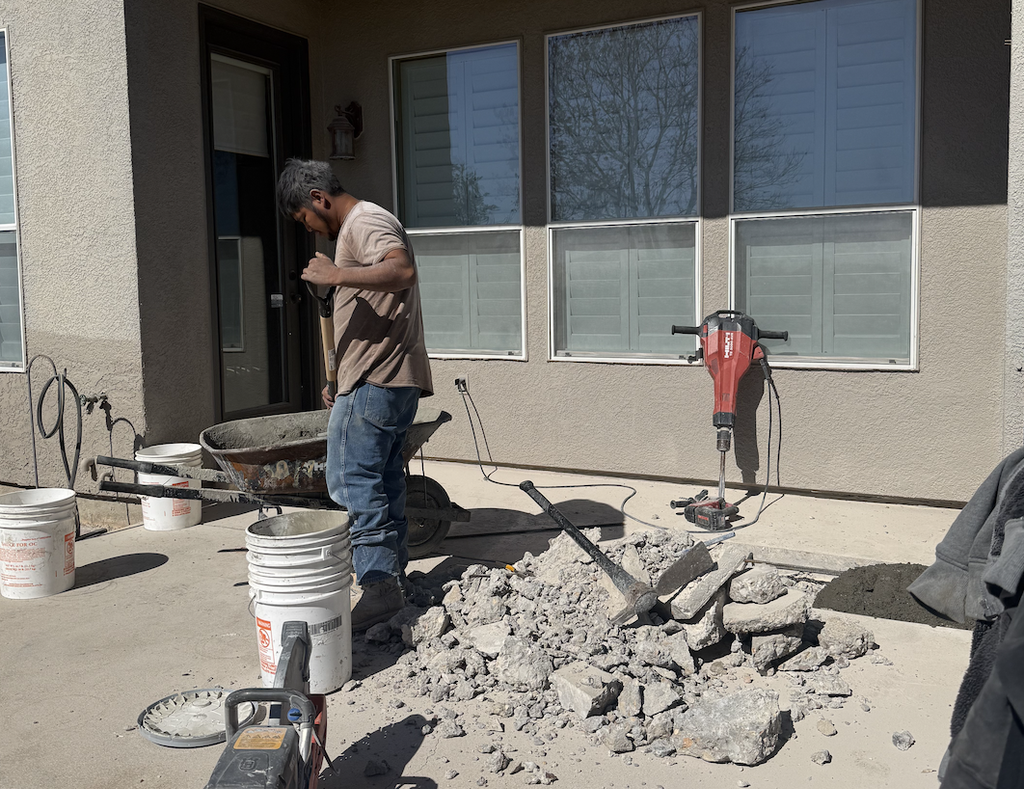
At that point it was clear the opportunity was real. Mere days after talking to Jeff Price, he’d cleared $500 profit on their first job, which bought them another ten days in ad spend to keep testing, and he had a real concrete guy in his corner.
If he had kept things just like that, it could have been quite the tidy side hustle – add a few more partners, ramp up ad spend, sell projects part time, and once they fixed their pricing, he and Ron would have hit the $200k target relatively fast. Indeed, they did hit that target about eight weeks into the experiment.
But there was one more lesson that really unlocked the business model, and helped them land a $3m sale.
For that, we must once more turn to Hancock’s past, for the breakthrough was, in his own words, “something I learned selling bracelets to yogis – a business I later sold to a twelve-year old for a million dollars.”
The Key Breakthrough
If you were into yoga around 2015-2016 there is at least an outside chance that you would have bought a yoga mat, jewelry, or some such other accouterment from John.
He an another business partner had created yogalifestyles.com, which grew to be one of the largest yoga communities on the English-speaking internet.
“We had competing marketing agencies that we owned,” he told me. “When you own that, you just sell everybody else’s stuff and eventually most people have this thought like, ‘We should be using all this all these resources to sell our own stuff!’ So we did that.”
They picked yoga because it was popular, and figured they could source mats and other accessories in China, then sell them via an email newsletter.
“Our bread and butter was content and commerce,” he said. “We were creating content knowing that we needed to end up selling yoga mats. But we didn’t know how to sell yoga mats. We just knew that when there was content there was commerce.”
They wrote articles on detoxes, aromatherapy, gemstones, and more, and in that process, stumbled on the concept of diffuser bracelets.
For the uninitiated, a diffuser bracelet is strung with a combination of lava rocks and gemstones. The lava rocks are porous, and if you dab one or two drops of essential oil on them, they’ll absorb it, and release the aroma throughout the day. The gemstones, meanwhile, are said to have different, more spiritual properties.

Whatever problem you got, John said, there’s a gemstone to heal it. “Depression, anxiety, sore back, I don’t know… Spirits.”
Diffuser bracelets typically go for $10-$20 online, but John and his business partner realized that by sourcing them on Alibaba, they could essentially give them away in exchange for a small shipping fee and the person’s email address.
“We were getting them for fifty-three cents, and charging $4.95 for shipping,” he said. “The $4.95 almost always covered it (but not always). But they were fucking flying and the emails were coming in.”
For a while, they just broke even, and figured that was worth it. The email addresses they were getting were from people with a proven interest in yoga and a willingness to enter their credit card info online – so John and his partner figured they could sell those same people mats, t-shirts, and more in the future.
But soon, they realized the business could be even simpler than that.
“Want to make this bracelet a set?” a one-click up-sell offered customers. For just $2 more, they could get a second band.
Suddenly, the business was profitable off the lead magnet alone, and this is what brings us back to concrete. Because, while gemstones and the trades don’t have much in common on the surface, it turns out selling them does.

“Here I am just screwing around with all the concrete stuff,” John said. “No business model, just learning – and while selling these random jobs and subbing them all out, I saw a pattern.”
The pattern was that when he called his contractors to bid a repair, they’d give him a quote, and end by saying, “…And if they want us to seal their expansion joints too, we can do it for $8 per foot.”
Buried in that throwaway line was the concept that not only unlocked the business for him, but also revealed all kinds of latent opportunity for other people trying to break into other trades.
In order for this to make sense, you don’t actually need to know what an expansion joint is (though you will doubtless recognize them if you watch the video below). You just need to know these three things…
- Contractors were treating them as an after-thought – a small upsell tacked onto much larger concrete projects
- They don’t have to be an after-thought – you can bid them alone, and “sealing” them extends the life of concrete helping avoid other expensive repairs
- They’re very inexpensive to work on compared to other concrete work
“This is by far the lowest-cost entry into anything concrete,” John said.
Whenever he found himself bidding stand-alone expansion joint jobs, people were thrilled just to hear numbers that didn’t start at five digits (a typical driveway might run just $800-$1,200, and ward off thousands in repairs).
Even when he added margin on top of his contractor’s pricing – testing $10 per foot, and later, $12 – people were happy to buy.
But the real game-changer was realizing that if he flipped the typical model, and lead by advertising for expansion joint projects rather than tacking them on as an upsell, he’d have a high-quality low-ticket offer to get people in the door and win them over.
“I started realizing, ‘Oh my god,’” he told me. “This is our bracelet.”
The brilliance of that insight was twofold.
First, it made his service incredibly easy to advertise. There was a clear target market (homeowners), a problem they could see in their own driveways, and most important, a price he could quote right in the ad itself – about $12 per linear foot.
“Right there, I take the scariness out of it,” he said. “You can’t do that with [other concrete projects] because you have no idea what it’s going to cost. You can’t begin to talk numbers in an advertisement.”
This actually led to one of his all-time killer ads (and here you can see what I’m talking about when I say he’s got a knack for marketing).
All of that made it easy for people to pick up the phone, and call him out for an estimate.
“If you’ve been getting quotes for anything in concrete, [it’s a lot],” he said. “Then you hear from me, and I’m like, ‘Yeah, [this option is] only twelve-hundred bucks, we’ve got a 5-year warranty on materials and craftsmanship, a 2-year money back guarantee, and this material itself should last you 20 plus years.'”
People loved it.
Once on-site, he essentially became their trusted advisor. If there was additional work that needed doing, he could bid that too. And if not, they could simply do the expansion joints, build the relationship, and be on-hand for any future needs.
“Now we’re good. We’re homies,” he continued. “I thought if we could just break even on joints, I’d become their concrete company of record. [Then] I’m the guy that they either use for leveling for repair when they need to pour a new patio out back, and/or recommend to their friends.”
That realization came at an important time for the business.
Just two months in, the numbers showed that he and Ron were already on track to hit their profit goal for the year (all while still only keeping part-time hours). This new “yoga-bracelet” sales tactic was already booking more leads than before, and if they leaned in fully, it was clear they’d blow right past their initial $200k target.
There was just one problem: His partners didn’t want stand-alone expansion joint jobs because they were so small.
This land-then-expand model is almost the exact opposite of how most contractors operate, not just in concrete, but across the industry. They want large projects, and the typical sales model is built around hunting those at the expense of anything small.
It actually creates an interesting opportunity for anyone who knows what to look for. Take roofing for example.
“Roofing guys want to do a $100,000 roofing job and then, you know, for an extra $2,000, they’ll go and do a spray sealant on your roof,” he said. “Well, fuck, that’s a good business, right?”
“Somebody who doesn’t necessarily want to have their roof redone right now, but would love to add five years of longevity to it – they can pay you $2,000 to be that guy that sprays?”
The same is true for dozens of different trades, he said. “In almost every trade, your business could be completely built on whatever their typical upsell is”
This Is The Model John Plans To Teach Others
Subcontracting had been enough to “replace” a full salary, and would have continued to be more lucrative over time. Meanwhile, sealing expansion joints was a specialized practice, with enough opportunity to warrant building his own team. So that’s what he did.
Together, they’re the twin sides of the model.
Training was a nightmare (the word “nightmare” appears no less than eleven times in our interview transcript – “disaster” also features prominently).
“Taking the wood out of of an expansion is really hard,” he said. “Everybody had new fresh and ripped open hands. Blood everywhere. It’s a brutal job.”
But they got through it, and actually got pretty good, mostly owing to that same old thing you see pop up throughout this piece – the willingness to figure things out one step at a time.
He continued bidding and subbing out large projects when they came up. “But once we actually started doing it and we started working out the economics, we realized, ‘Oh my god, we’re going to make money hand over fist, even if we don’t do that other stuff.’”
One thing that helped was paying the crew well – Ron & John paid their guys 5-7x the typical rate for joint-sealing work, plus incentives for door-knocking and landing other jobs. That helped attract the right kind of people, and keep turnover in check.
Another thing that gave them an edge was the fact that they started building custom software to power the entire business – everything from developing ad creative, to managing pipeline, to scheduling jobs, handling payment, analyzing ROAS, and more.
Less than two months after starting his team (part of which included a two-week vacation in Germany), they’d hit $300k in annualized profit with a single crew, and were debating whether to start another, when a chance connection with Reawaken Capital led to an acquisition offer they hadn’t been expecting.
“They’re a private equity company that owns 245 homes,” he said. “They’re trying to grow, and they were in the process of sourcing home services businesses to buy.”
The plan was for said acquisitions to service RC’s properties as well as others in the market – turning their maintenance costs into a profit center as they grew their portfolio.
John’s playbook for breaking into local markets was valuable enough to land a 10x earnings valuation, and after some light back-and-forth, and the smoothest diligence process he’d ever been through, the papers were signed on July 10th, barely eighteen weeks after Jeff Price joined the zoom call with John.
The timing was perfect.
He and Ron got into this game to teach people how to future-proof their income, and that’s exactly what they intend to do, via Groundwork, a new community they’re starting for people in tech who are interested in building a profitable trades business to protect or bolster their income.
Inside they’re teaching the full playbook – how to advertise, sell, build partnerships with local contractors, and expand margins as new opportunities present themselves.
Speaking of opportunities, there are plenty of those – window washing, bugs and termite prevention, painting curbs, even grill cleaning all came up as part of our conversation.
“Almost every day I found a trade that would have been way better for my skill set,” he said. “We just were in concrete.”