Get Free

He Bootstrapped A Concrete Company With $50 And Sold It Five Months Later For $3M

What follows here has got to be one of my all-time favorite business stories – that of my friend John Hancock, a long-time internet entrepreneur, who recently bootstrapped a concrete company with $50 in startup capital, and sold it less than five months later for three million dollars.

If you know me personally, you know I haven’t stopped talking about this since the deal officially happened back in July, and as I sit here putting the finishing touches on this profile, I think I see what I liked about the story so much…

It’s not just the numbers (though those would be impressive for any business owner). 

It’s the fact that so much of this was so unexpected. John started this project as a test to see if it was possible for someone in tech to replace their income by working part time, on the side, in the trades. He had no experience there, and no contacts. Just curiosity coupled with the willingness to take little steps when most people pause.

I’ll let you judge for yourself how it turned out.

Then, there is also the timeliness. Right as AI is reshaping everything, a question has started to circulate throughout the tech community: “Is my livelihood safe? And if not, what the hell should I be doing about it?”

As you’ll see, John’s been thinking about that very question for almost a decade now – since long before most people ever thought it’d be an issue.

To understand why (and how it led to him bleeding in his driveway with three strangers) let me first take you back in time…

The Story Begins In The Fall Of 2020…

Hancock and his then-business partner had just launched a brand new media company called Stonks, which started off as an irreverent take on stock market news, and grew into a massive startup funding platform that helped founders raise well over $100m via virtual demo days.

Early on, you might not have guessed what it was headed for though.

Inspired by the burgeoning Wall Street Bets community, which won global attention in 2021 for the role they played in the GameStop short squeeze, Stonks leaned into the aggressive, fast-paced, self-deprecating humor of the times. “So easy, even your wife’s boyfriend could do it,” went the common tagline.

“It was just the most vulgar, upsetting [thing],” he chuckled in our interview. “I don’t know why. If you look at the Internet Archive, and you go back to December 2020, it’ll say in 120-point font, ‘Due Diligence for Retards.’ Like, that was our brand.”

Anyone who reads that and finds themselves reflexively clutching for their pearls can take heart in knowing that John was, in fact, mis-remembering. For I checked the internet archive, and the headline he mentioned doesn’t appear there until January of 2021 (and even then, it’s in a very modest size thirty-three font).

No, at the end of 2020, Stonks’ homepage was a much more buttoned-down video of Dave Portnoy in a tank top, yelling at CNBC’s Ron Insana, and pulling random scrabble tiles out of a bag in order to pick stock tickers.

Still, you get the picture – Stonks was a wildcard.

And their voice wasn’t the only unique thing about them. John and his co-founder were years ahead of the rest of the media industry on something that’d change the world.
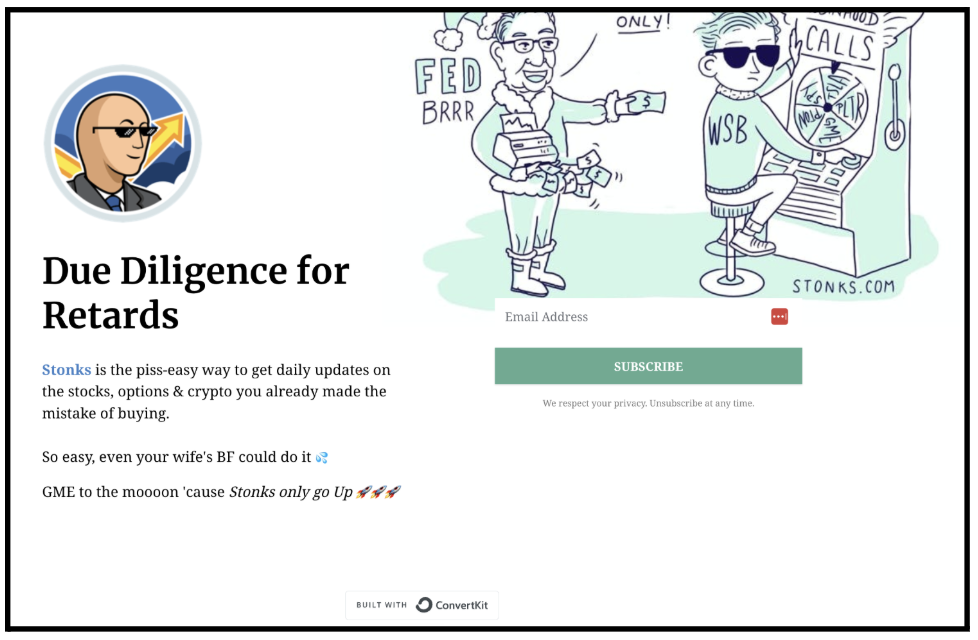
Screenshot of Stonks.com from The Internet Archive’s Wayback Machine, January, 2021

“There was this new insane technology which nobody was really using yet called speech transformers,” he told me.

Transformers are a form of deep learning architecture used to develop some LLMs. In fact, they are the ‘T’ in “GPT.”

Speech transformers deal particularly with spoken language (e.g., transcribing earnings calls), and very few media companies were experimenting seriously with them or any other AI tools back then. But Stonks was, and they hit on a use that ended up being a nice growth hack: Customization.

At the time, they had about 2,500 newsletter subscribers, and using AI, they made sure each person got something in their email that was unique from everybody else’s. People would tweet screenshots comparing witty lines, and it drove a bunch of engagement and visibility, all from content that wasn’t human-written.

“I remember seeing that and thinking, ‘I wonder if copywriters are in trouble,’” John said.

Now, because it’s been approximately six-hundred years since 2020, you’ve probably lost sight of just how far ahead of the curve he was on this particular insight.

Allow me to remind you: This was still two full years before the release of ChatGPT. Stonks would have been one of less than three-hundred projects in the world actively using GPT-3’s API to generate output. And that output would have appeared far from threatening to most human writers.

In fact, I have some personal experience with this.

Around the very same time, I too had early access to GPT-3 via the company I was writing for, and as an experiment, I fed it the first few lines of Melville’s Moby Dick, just to see what it’d do.

What it did was write one or two paragraphs of hauntingly beautiful prose about the freedom of a life at sea, before careening off onto an insane tirade about how whales are like Holland cheeses.

Simply put, the technology was barely capable of stringing together human-ish writing.

So John was definitely early.

But that question – about how AI would affect job security in the tech industry – stuck with him. 

It was the lead domino that tipped off a series of events that followed him through each of his projects over the coming years, and was, in its own way, the genesis for the concrete company as well as what came after.
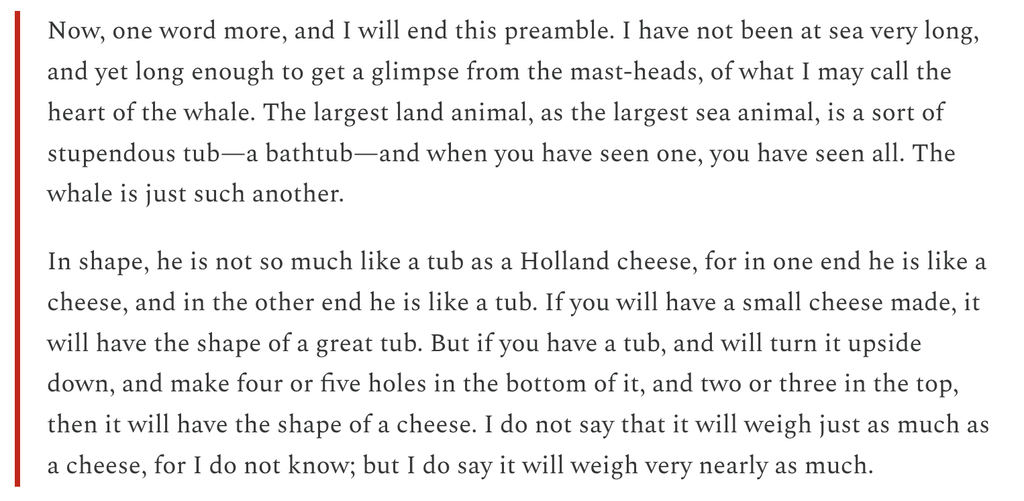
Screenshot from my experiment with GPT-3, circa 2020

Stonks continued to be on the leading edge of AI use in the early 2020s. As capabilities grew, John foresaw more and more white collar jobs being disrupted and reshaped.

“This was before it could code,” he said. “Very early days. But even then, I thought it might evolve to a point where the typical tech founder could just be non-technical.”

So he started a newsletter called Founders Only, and wrote about what he was seeing, both as a founder himself, and also, someone who was helping other founders raise millions on a regular basis.

“Slowly, over time, I started writing more and more content about what’s going to happen if you just keep being a startup founder and you don’t actually have a way to future-proof your income,” he said. “It started to occupy my thoughts quite a bit.”

He Exited Stonks In 2024

By that point, AI was the main thing on his mind. He spent a year or so taking odd consulting jobs, but through it all, the issue of AI displacement kept coming back to him, and much of the work he found himself doing involved teaching companies, if not how to fully replace people with AI, at the very least, how to avoid hiring more of them.

As ‘25 gave way to ‘26 two things happened that changed the course of his life significantly.

First, he and his friend, Ron, started working on a new business – they were looking for something future-proof.

“We’d ask, ‘What’s going to be left in five years,’ and we would think, ‘Okay, well, people are still going to buy stuff,’” he said. 

“And we’re like, ‘Okay, well, do we want to do a store? No. We like software.’ So we thought, ‘What if we build an app that helps facilitate the purchase of physical goods?’”

Prior to Stonks, John had built a few successful ecommerce brands.

In one of them, he ran a playbook where he had a small team of people whose sole job was to email shoppers who’d abandoned their carts, chat with them as though they were him, and offer them bespoke deals (directly from the “founder”) that got them to buy.

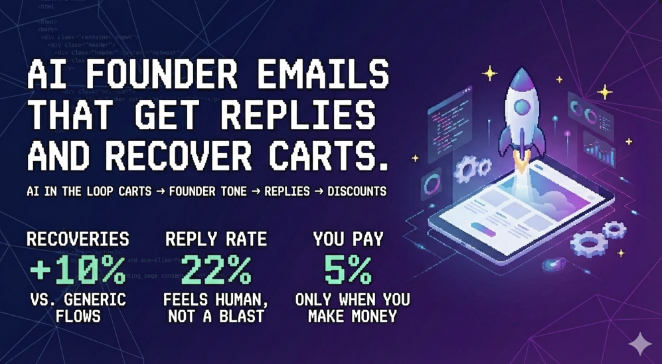
AI chatbots now made it possible to run the same sequence at scale, automatically, so he and Ron got to work building software to do exactly that. They called it Stanly, and the early signs were promising.

“It looked really good,” he said. “We were signing on new stores all the time. I thought it was definitely going to work. Then I had this fucking conversation…”
The conversation was with a reader from his newsletter. Still obsessed with the question of how to future-proof your income, he’d put the word out to readers that he was thinking of starting a podcast, and people should reply if they wanted to be on an episode.

Dozens of responses came back, but one caught his eye in particular: 

“This is probably not what you’re looking for,” it read, “but I recently started a concrete company, and we’re doing pretty well.”

The note came from Jeff Price, an entrepreneur based in Houston.

Jeff, who’s been public about his numbers, was a former software developer who started Texas Slab Guys in 2025. By the time he talked to John earlier this year, things were off to a good start, and as of this writing, he was on-track for $2m in 2026 revenue just a little over a year after starting.

“I was like, ‘Him first,’” John told me. “I’ve gotta talk to him right away.”

The conversation went well – you can actually watch it here – and by the end, John felt an inescapable urge to try this business.

“It was just the most future-proof thing I could imagine,” he said. “If you were to make a list of the most future-proof things ever – something that the Optimus robot isn’t going to do anytime soon – it was this.” 

I think there was something else too. Something you might not spot if you didn’t know what you were looking for. 

In a career spent talking to founders, John is one of the better salesmen I’ve ever bumped into. Most people don’t notice it at first (probably part of why he’s so good at selling).

But he has built five other million dollar companies. He’s spent ten years teaching a sales framework he designed to teams around the world. In fact, he has a lifetime 50% discount on Enterprise car rentals because he once taught that framework to a VP at Berkshire Hathaway, who went on to teach it to 1,500 employees and gave him the discount as a personal thank-you.

So while he didn’t necessarily come right out and say this, my bet is that the moment he got a look at the world of blue-collar trades, he (rightly) realized he could sell circles around anyone else competing there.

“I remember thinking, ‘I’m going to knock this out of the park.’” he told me in our interview. 

He asked for Price’s blessing, and got it.

“He said, ‘You’re in Austin. I’m in Houston. Go for it. But you should know it’s not a good business in Austin.” Price was doing something called “concrete leveling,” which is a specific type of concrete work, much more commonly needed in Houston’s sub-tropical marshland than it is on the rugged stone escarpment that lies beneath Austin.

That was not enough to dissuade him.

So all that was left was to go to his business partner, Ron – currently several months into a software build that looked like it was going to be a raging success – and convince him to change course entirely.

“I said, ‘Let’s be real, Ron – in five years, every store in the world is going to be able to speak this app into existence with Claude, right? So, have we done anything truly future-proof, or have we just built another thing that’ll be replaced?’” 

There was a bigger vision too. John wanted to teach tech people how to future-proof their income, which meant he needed to build something other people could replicate. If he and Ron got the concrete business to work, he bet they could teach others how to do that or other trades. 

But people would only listen if they could prove the model themselves. So they set their sites on $200k in profit – enough to replace a mid-level tech salary – and agreed to limit themselves to part-time work in the beginning.

“He was like, ‘Okay, let’s do it,’” John told me. “So we stopped working on Stanly and instantly within one day we’re working on concrete.”

Tech Guys Get Into The Concrete Business

There is a certain perfect kind of irony in what happened next. In their quest to break into an industry that AI hadn’t made obsolete, John and his co-founder used AI to do… well… almost everything.

That first night, they sat in a Slack huddle, pinging ChatGPT with questions. 

They asked what they should call the business, and one of the options that came back – Hill Country Slabs – sounded like the right fit. 

The domain was available, so they bought it, then had Chat make a logo, design a landing page, write the bio for their Facebook page, and sketch out options for their first Meta ads.

Within a day of his conversation with Jeff Price, they were live, running ads, with a $50/day budget.

What’s fascinating here is the speed-to-execution. You hear about entrepreneurs being quick to act, but to see what that actually looks like for someone who’s working on their sixth company – the cycle time is just so much shorter than most people expect.

“We had eight leads on day one,” John told me, “and I was like, ‘Ron, this is a business, baby! Let’s sell. Let’s do what we do best.’”

Then he picked up the phone and started dialing.

At this point, you may pause to wonder what either of them knew about concrete? 

The answer is: Almost nothing.

As John pointed out in our interview, he doesn’t own a house – he’s a perennial renter – so concrete and its maintenance had never even risen to the realm of his attention before that day.

The plan was to sell a job under the Hill Country Slabs brand, then sub-contract it out to another local concrete company, essentially capitalizing on John’s ability to market and sell, and taking a cut on the arbitrage.

“Yes, but don’t you need to know something about concrete in order to sell it?” I hear you wonder.

And here the answer is, “ChatGPT to the rescue again.”

“Of our first batch of leads, one of them became our first customer,” John told me. “I’ll never forget it.”

The man was actually a renter too. He had a condo with a patio, and a small 2’x5’ pad that had cracked and needed replacing.

John took the call on speaker-phone, so his hands were free to type.

He asked ChatGPT which questions he should ask in order to bid the job. The prospect talked, John relayed his answers to the AI, and in the end, Chat spit out three prices: $900 for a budget option, $1350 mid-range, and $1700 premium.

Not wanting to fly too close to the sun on their first sales call, he opted for the middle of the road quote.

“I tell him, ‘Yeah, it’d be about $1350,’” John said, “and he was like, ‘Okay, when can you come out?’ I said, ‘Let me call you back.’”

He hung up, and instantly started calling concrete companies, and that was just about the moment that it became painfully clear that ChatGPT also didn’t know how to price concrete jobs.

The first contractor who answered hung up almost instantly.

The second was more patient. He listened as John talked through the size of the pad, damage, etc, thought for a minute, and told him that his team would take the job, and it’d probably run around $2,000.

“I was like, ‘Can you do it for eight-hundred?’” John said. “And he was like, ‘Did you charge $800?’” 

[Long pause] “Yes.”

The man sighed, said they’d do it, but that he was going to have to teach John how to price better if they were going to work together like this. From that point forward he became a kind of mentor – the first in a series of local contractors who were willing to take him in and teach him the trade.

This openness, and willingness to teach was one of the distinguishing characteristics about the trades that came up multiple times throughout the course of our chat.

“Everybody’s so nice,” he said. “And I mean everybody – they’re so cool, so nice, so down to earth.”
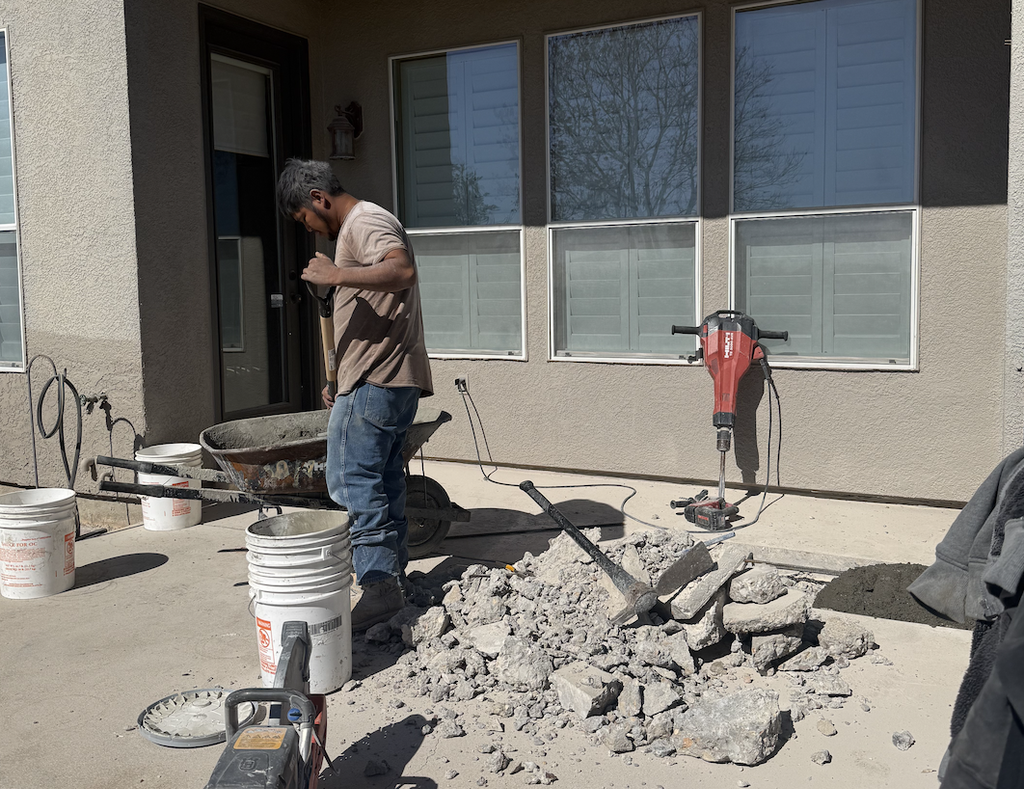
A shot from the first project

At that point it was clear the opportunity was real. Mere days after talking to Jeff Price, he’d cleared $500 profit on their first job, which bought them another ten days in ad spend to keep testing, and he had a real concrete guy in his corner.

If he had kept things just like that, it could have been quite the tidy side hustle – add a few more partners, ramp up ad spend, sell projects part time, and once they fixed their pricing, he and Ron would have hit the $200k target relatively fast. Indeed, they did hit that target about eight weeks into the experiment.

But there was one more lesson that really unlocked the business model, and helped them land a $3m sale.

For that, we must once more turn to Hancock’s past, for the breakthrough was, in his own words, “something I learned selling bracelets to yogis – a business I later sold to a twelve-year old for a million dollars.”

The Key Breakthrough

If you were into yoga around 2015-2016 there is at least an outside chance that you would have bought a yoga mat, jewelry, or some such other accouterment from John.

He an another business partner had created yogalifestyles.com, which grew to be one of the largest yoga communities on the English-speaking internet.

“We had competing marketing agencies that we owned,” he told me. “When you own that, you just sell everybody else’s stuff and eventually most people have this thought like, ‘We should be using all this all these resources to sell our own stuff!’ So we did that.”

They picked yoga because it was popular, and figured they could source mats and other accessories in China, then sell them via an email newsletter.

“Our bread and butter was content and commerce,” he said. “We were creating content knowing that we needed to end up selling yoga mats. But we didn’t know how to sell yoga mats. We just knew that when there was content there was commerce.”

They wrote articles on detoxes, aromatherapy, gemstones, and more, and in that process, stumbled on the concept of diffuser bracelets.

For the uninitiated, a diffuser bracelet is strung with a combination of lava rocks and gemstones. The lava rocks are porous, and if you dab one or two drops of essential oil on them, they’ll absorb it, and release the aroma throughout the day. The gemstones, meanwhile, are said to have different, more spiritual properties.

Whatever problem you got, John said, there’s a gemstone to heal it. “Depression, anxiety, sore back, I don’t know… Spirits.”

Diffuser bracelets typically go for $10-$20 online, but John and his business partner realized that by sourcing them on Alibaba, they could essentially give them away in exchange for a small shipping fee and the person’s email address.

“We were getting them for fifty-three cents, and charging $4.95 for shipping,” he said. “The $4.95 almost always covered it (but not always). But they were fucking flying and the emails were coming in.”

For a while, they just broke even, and figured that was worth it. The email addresses they were getting were from people with a proven interest in yoga and a willingness to enter their credit card info online – so John and his partner figured they could sell those same people mats, t-shirts, and more in the future. 

But soon, they realized the business could be even simpler than that.

“Want to make this bracelet a set?” a one-click up-sell offered customers. For just $2 more, they could get a second band. 

Suddenly, the business was profitable off the lead magnet alone, and this is what brings us back to concrete. Because, while gemstones and the trades don’t have much in common on the surface, it turns out selling them does.
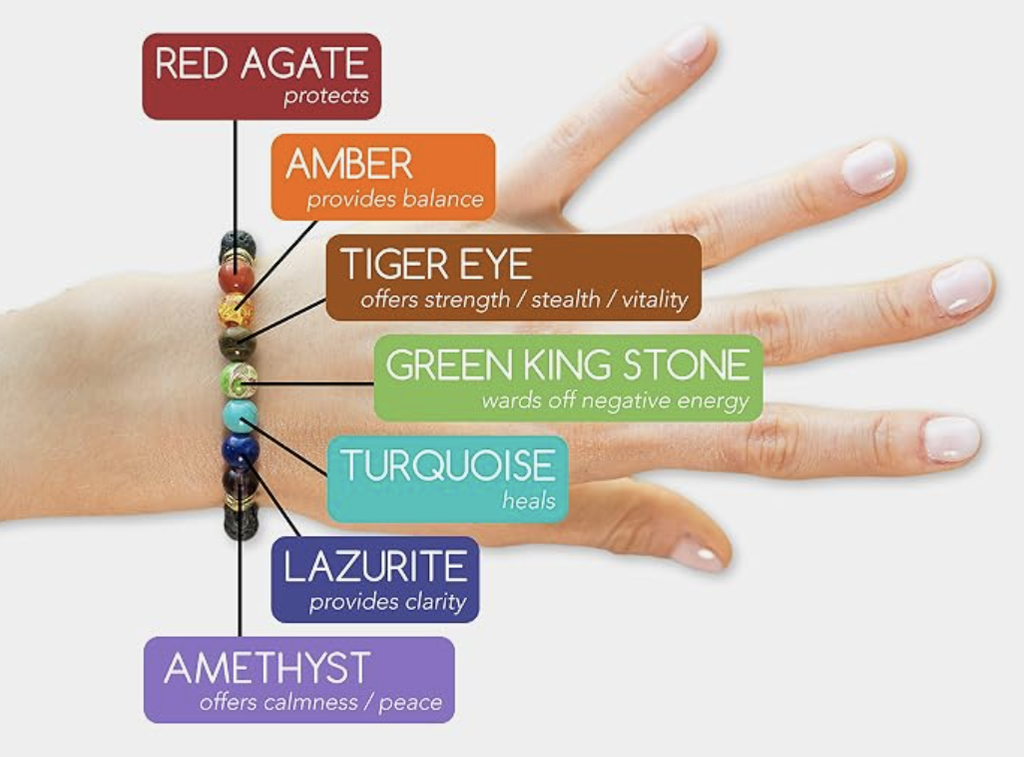
Fun Fact: The bracelet company kicked off $300k in profit once they figured out the lead magnet tactic, and they spun it out as jewelery.yoga, and sold it for $1m. The buyer? A twelve year old girl named Maddi Bella who was running an even bigger FBA store in the same space at the time.

“Here I am just screwing around with all the concrete stuff,” John said. “No business model, just learning – and while selling these random jobs and subbing them all out, I saw a pattern.”

The pattern was that when he called his contractors to bid a repair, they’d give him a quote, and end by saying, “…And if they want us to seal their expansion joints too, we can do it for $8 per foot.”

Buried in that throwaway line was the concept that not only unlocked the business for him, but also revealed all kinds of latent opportunity for other people trying to break into other trades.

In order for this to make sense, you don’t actually need to know what an expansion joint is (though you will doubtless recognize them if you watch the video below). You just need to know these three things…

  1. Contractors were treating them as an after-thought – a small upsell tacked onto much larger concrete projects
  1. They don’t have to be an after-thought – you can bid them alone, and “sealing” them extends the life of concrete helping avoid other expensive repairs
  1. They’re very inexpensive to work on compared to other concrete work

“This is by far the lowest-cost entry into anything concrete,” John said.

Whenever he found himself bidding stand-alone expansion joint jobs, people were thrilled just to hear numbers that didn’t start at five digits (a typical driveway might run just $800-$1,200, and ward off thousands in repairs).

Even when he added margin on top of his contractor’s pricing – testing $10 per foot, and later, $12 – people were happy to buy.

But the real game-changer was realizing that if he flipped the typical model, and lead by advertising for expansion joint projects rather than tacking them on as an upsell, he’d have a high-quality low-ticket offer to get people in the door and win them over.

“I started realizing, ‘Oh my god,’” he told me. “This is our bracelet.”

The brilliance of that insight was twofold.

First, it made his service incredibly easy to advertise. There was a clear target market (homeowners), a problem they could see in their own driveways, and most important, a price he could quote right in the ad itself – about $12 per linear foot.

“Right there, I take the scariness out of it,” he said. “You can’t do that with [other concrete projects] because you have no idea what it’s going to cost. You can’t begin to talk numbers in an advertisement.”

This actually led to one of his all-time killer ads (and here you can see what I’m talking about when I say he’s got a knack for marketing).

All of that made it easy for people to pick up the phone, and call him out for an estimate.

“If you’ve been getting quotes for anything in concrete, [it’s a lot],” he said. “Then you hear from me, and I’m like, ‘Yeah, [this option is] only twelve-hundred bucks, we’ve got a 5-year warranty on materials and craftsmanship, a 2-year money back guarantee, and this material itself should last you 20 plus years.'”

People loved it.

Once on-site, he essentially became their trusted advisor. If there was additional work that needed doing, he could bid that too. And if not, they could simply do the expansion joints, build the relationship, and be on-hand for any future needs.

“Now we’re good. We’re homies,” he continued. “I thought if we could just break even on joints, I’d become their concrete company of record. [Then] I’m the guy that they either use for leveling for repair when they need to pour a new patio out back, and/or recommend to their friends.”

That realization came at an important time for the business.

Just two months in, the numbers showed that he and Ron were already on track to hit their profit goal for the year (all while still only keeping part-time hours). This new “yoga-bracelet” sales tactic was already booking more leads than before, and if they leaned in fully, it was clear they’d blow right past their initial $200k target.

There was just one problem: His partners didn’t want stand-alone expansion joint jobs because they were so small. 

This land-then-expand model is almost the exact opposite of how most contractors operate, not just in concrete, but across the industry. They want large projects, and the typical sales model is built around hunting those at the expense of anything small.

It actually creates an interesting opportunity for anyone who knows what to look for. Take roofing for example.

“Roofing guys want to do a $100,000 roofing job and then, you know, for an extra $2,000, they’ll go and do a spray sealant on your roof,” he said. “Well, fuck, that’s a good business, right?”

“Somebody who doesn’t necessarily want to have their roof redone right now, but would love to add five years of longevity to it – they can pay you $2,000 to be that guy that sprays?”

The same is true for dozens of different trades, he said. “In almost every trade, your business could be completely built on whatever their typical upsell is”

This Is The Model John Plans To Teach Others

Subcontracting had been enough to “replace” a full salary, and would have continued to be more lucrative over time. Meanwhile, sealing expansion joints was a specialized practice, with enough opportunity to warrant building his own team. So that’s what he did.

Together, they’re the twin sides of the model.

Training was a nightmare (the word “nightmare” appears no less than eleven times in our interview transcript – “disaster” also features prominently).

“Taking the wood out of of an expansion is really hard,” he said. “Everybody had new fresh and ripped open hands. Blood everywhere. It’s a brutal job.”

But they got through it, and actually got pretty good, mostly owing to that same old thing you see pop up throughout this piece – the willingness to figure things out one step at a time.

He continued bidding and subbing out large projects when they came up. “But once we actually started doing it and we started working out the economics, we realized, ‘Oh my god, we’re going to make money hand over fist, even if we don’t do that other stuff.’”

One thing that helped was paying the crew well – Ron & John paid their guys 5-7x the typical rate for joint-sealing work, plus incentives for door-knocking and landing other jobs. That helped attract the right kind of people, and keep turnover in check.

Another thing that gave them an edge was the fact that they started building custom software to power the entire business – everything from developing ad creative, to managing pipeline, to scheduling jobs, handling payment, analyzing ROAS, and more.

Less than two months after starting his team (part of which included a two-week vacation in Germany), they’d hit $300k in annualized profit with a single crew, and were debating whether to start another, when a chance connection with Reawaken Capital led to an acquisition offer they hadn’t been expecting.

“They’re a private equity company that owns 245 homes,” he said. “They’re trying to grow, and they were in the process of sourcing home services businesses to buy.”

The plan was for said acquisitions to service RC’s properties as well as others in the market – turning their maintenance costs into a profit center as they grew their portfolio. 

John’s playbook for breaking into local markets was valuable enough to land a 10x earnings valuation, and after some light back-and-forth, and the smoothest diligence process he’d ever been through, the papers were signed on July 10th, barely eighteen weeks after Jeff Price joined the zoom call with John.

The timing was perfect.

He and Ron got into this game to teach people how to future-proof their income, and that’s exactly what they intend to do, via Groundwork, a new community they’re starting for people in tech who are interested in building a profitable trades business to protect or bolster their income.

Inside they’re teaching the full playbook – how to advertise, sell, build partnerships with local contractors, and expand margins as new opportunities present themselves.

Speaking of opportunities, there are plenty of those – window washing, bugs and termite prevention, painting curbs, even grill cleaning all came up as part of our conversation.

“Almost every day I found a trade that would have been way better for my skill set,” he said. “We just were in concrete.”

Being An Attacking Player, In Chess, Business, And Life

I was early to the party on pickleball. So early, in fact, that when I suggested doing a story about it to my editor at The Hustle, he eyed me reservedly, as if deciding whether to cast me into the desert or merely get me some kind of brain doctor, then asked me to think of something else.

A few weeks later, covid happened, pickleball became the biggest thing ever, and I was granted the only point I ever scored in the perpetual rally with my wise and sage editor, who (as all writers know) was essentially right about everything else, forever, always.

Anyways, given how early I was to the dink, it’s a bit of a surprise that I seem to be one of the last to hear about padel (I think, from a Chris Williamson pod).

I’ll tell you right now, it’s got all the same energy as those early pickleball days, and so I was stoked to come across Evan Meyers, and notice he was building some of the first indoor padel courts to Austin.

I knew we had to get him in here.

Padel Society, which is set to open later this month, is home to six air-conditioned courts, a full bar, red light saunas, golf simulator, and a full coworking space.

So without further ado, here’s Evan…

Rendering

1. Okay, tell us about your business! What's the backstory? And how did you get your first customer. 

It all started with a hobby. I moved to Austin, started playing pickleball to meet new people and get involved with the community. A friend of mine told me about Padel, he brought me to play for the first time in early 2024 and I immediately got hooked. I could see why it was the fastest growing sport in the world.

I got obsessed, started playing 3-4x a week. Met a lot of great people along the way, including my two Co-Founders and great friends, Andres Iturbide Beltran and Thanh Pham. 

It started as a very plain and simple idea. We played and it was hot outside and we wanted to play longer but couldn’t bear the sun. Why not build padel indoors in AC?

Well we started doing more research and realized it’s a very successful business model in other markets and we set out on our journey from there.

Two years later, we’re set to open doors at the end of Sept 2026.

We sold out our founding memberships, with nearly 130 sold in just four days. Our original goal was 100, but we ultimately had to close sales to preserve the member experience. That early demand has been incredibly validating and has us even more excited to bring a premium indoor padel club to Austin.

2. What’s one unconventional decision you made early in your business that you believe set you apart from competitors, and how do you think it shaped your trajectory?

Patiently waiting to build the right facility in the right location rather than rushing to be one of the first in Austin. Padel is on an amazing trajectory in the US and in ATX. With that, every part of us wanted to get open as quickly as possible. We came very close to forcing the wrong warehouse, the wrong location, and ultimately we wouldn’t have built the premium experience we’re looking to bring with Padel Society. 

With that, we made a collective decision that if it meant opening up a 9 months later but it means we don’t cut a single corner, that is how we want to build this out. Great things take time. We have nearly 40 foot ceilings for top level play, AC, premium amenities, and a design with purpose that puts a center 360 bar in between all of the courts. I think when people walk into Padel Society they will see the attention to detail, the investment we made to provide a top notch facility and experience and we’re very proud of that.

Early days at the warehouse

3. What’s one book most people have never even heard of that you think is worth reading. (DIG DEEP – we’re looking for the books you’ll never see on the NYT list)

The Life and Games of Mikhail Tal – alright so admittedly I’m a huge chess nerd. I’m obsessed, borderline addiction. In between meetings if I have 5-10 minutes of downtime I’ll play a game of chess online. Chess has taught me a lot about life.

A few things I really love about Mikhail Tal: 

First, he played the game unconventionally. He did things others didn’t see, sacrificed pieces, found creative openings, he zigged where others zagged. I love that when it comes to life. There are so many ways to go about life and ultimately there isn’t one right or wrong way.

The only wrong way in my opinion is not playing the game at all. Go out there, fail, try again, fail again, and keep playing the game (chess or life depending how you read this). This is how I’ve always wanted to build a business and live my life. We get one shot at this thing, I didn’t want to be in the corporate race for 50 years and retire and that’s it. I want to wake up and have passion for what I’m doing. 

Second, I think chess can teach a lot of people valuable lessons in the game of life. Very rarely when something impacts our life, is the first gut reaction, immediate emotional response the right move. Sometimes, being the one to sit back, observe, and try to think 3-5 moves ahead is the one that finds the right move. I take a lot of pride in being patient and analytical and trying not to make rash decisions. 

Lastly, if I’m going full chess nerd here, Mikhail was an attacking player. I think that is an awesome mentality. Be bold and take some risk. Throw some stuff at the wall and see what sticks. I don’t want to wait for opportunities to come land in my lap, I want to create them. So when Andres, Thanh, and I all agreed that one day someone would eventually build indoor padel in Austin; we all were on the same page, lets take action, let’s be the one to go after it!

An early render of the space

4. What’s one belief about entrepreneurship you held when you started that you’ve completely abandoned, and what made you change your mind?

That people are natural born entrepreneurs. Entrepreneurship isn’t a random skill you’re born with. What’s changed my mind is building out Padel Society. Go through 2 years of ups and downs, fundraising, dealing with real estate, failing a few times, and persevering through it. Not to mention going from a well paying job to no salary for a year. It’s really tough.

I think people romanticize and underestimate the sacrifice it takes to actually do it. I think one of the biggest strengths an entrepreneur can have is the tenacity to believe in your vision, in themselves, and in their co-founders and to keep going after it and fight through adversity. 

5. What’s one purchase of less than $1,000 that’s made the biggest impact on your happiness, health, or wealth?

My pup Hank. He was technically $50 adoption fee so cheat answer here. Wealth is a very loose definition, to me it doesn’t necessarily mean how much money is in your bank account. Having an amazing support system at home that includes my fiance and two awesome dogs is what really matters to me and keeps me going.

6. (Optional) Are you married? If so, how’d you meet your spouse, and what role have they played in your entrepreneurial journey?

Engaged, getting married October 3rd this fall. Going to be a crazy next two months. We met in a dog park 4 years ago in Austin, both of us from Virginia randomly met in ATX and haven’t looked back since. I wouldn’t possibly be where I am right now with this if it wasn’t for Erika.

She’s the one that pushed me to quit my full time sales job and go all in on this. She’s been an incredible support system and Padel Society wouldn’t exist without her. Find you someone who buys you extra guac at Chipotle when you’re on a broke entrepreneur journey, she’s a keeper.

7. If you were to recommend one under-the-radar Austin spot to another founder for brainstorming or unwinding, where would it be and why?

The Krieg baseball fields. Will take the dog off leash over there to throw him the ball. It’s a great place to get outside, have some peace and quiet, and have enough time to yourself to properly think.

You can connect with Evan here, follow Padel Society on Instagram, or check out their site for full information on memberships, pricing, and more.

“You Start To Realize No One Has All The Answers”

Nick Hellman is the co-founder of Keyveve, an AI-powered platform for accounting, advisory, wealth management, and consulting firms, designed to help centralize all the key documents they use with clients, and automate a lot of the heavy lifting with agents.

It’s his second company, and in this piece, he reflects on the lessons learned between startups numbers one and two – from meeting his co-founder online, to over-investing in their first product, to now, taking a different approach to PMF this time around.

He is also somehow able to recommend a book I’ve never heard of in twenty years of nerding out on business books (always something I enjoy).

So without further ado, here’s Nick 👇

1. Okay, tell us about your business! What’s the backstory? And how did you get your first customer. 

It all started when I met my cofounder and CTO, Udeme Ekanem, through Y-Combinator’s co-founder matching platform. At the time, we were two inexperienced entrepreneurs trying to figure things out as we went, but we shared a common goal of building a meaningful company.

We learned a great deal through our first business, a financial-technology startup.

We made plenty of mistakes along the way, including building too much before fully understanding what customers actually wanted. We were bootstrapping the company, and I invested far too much of my own money into a product that ultimately did not have the customer demand we expected.

That experience completely changed how we approached Keyveve.

Because I came from the accounting-technology industry, we had a general interest in solving problems for accounting firms.

When we started working on the business in February 2025, we made a deliberate decision not to rush into building. Instead, we began speaking with industry thought leaders and potential customers to understand how firms actually operated, where their teams were losing time, and which problems were painful enough to justify adopting a new product.

In the early days, we spoke with more than 60 accounting firms. Those conversations helped us understand the challenges firms were facing and gave us confidence that there was a genuine need in the market.

Udeme then led the technical development of the platform, translating what we were hearing from firms into the product itself while shaping its architecture, core workflows, and AI capabilities. He continuously refined the software around feedback from firm leaders and practitioners, turning customer conversations into a practical product designed around how accounting and advisory teams actually work.

Our first customer came from one of those early conversations. They saw the potential in what we were building before many others did and were willing to take a chance on us.

Is the solution perfect? No. In entrepreneurship, the product is always a work in progress.

But I believe that when you maintain a disciplined commitment to listening to your customers and understanding the market you serve, you give yourself the best chance of building something people genuinely need. That has become our North Star at Keyveve.

2. What’s one unconventional decision you made early in your business that you believe set you apart from competitors, and how do you think it shaped your trajectory?

Taking our time in the beginning and doing the extra leg work in the beginning to get the need right.

In today’s world, founders think they have to rush a product to market but I always believed in running your own race in the entrepreneurial world and that extra time you take in the beginning will lay a solid foundation for the future of the business.

As an entrepreneur it is easy to feel like you are behind when you go on social media but you are not late, you are on time and working through the process.

I think this extra time spent  that I mentioned also shaped the future roadmap from a technology perspective with our market audience. Doing this builds a future sales pipeline and gains trust with your perspective audience

3. What’s one book most people have never even heard of that you think is worth reading. (DIG DEEP – we’re looking for the books you’ll never see on the NYT list)

One of my favorite books that I have read a few times and one that should be on the bookshelf of any entrepreneur, no matter where they are in the journey. The book is called Disciplined Entrepreneurship: 24 Steps To A Successful Startup by Bill Aulet.

It has a picture book type format that breaks down steps from market segmentation to developing a product plan.

It’s a quick read and breaks down the process in steps which I think can be helpful for any entrepreneur as it can be easy to get overwhelmed with all the different things needed to start a business.

4. What’s one belief about entrepreneurship you held when you started that you’ve completely abandoned, and what made you change your mind?

Before I started my entrepreneurial journey, I had a strong conviction that to be successful you had to have all the answers and any product that you build would be a hit and everyone would buy it.

Between our first business not working out and getting experience as an entrepreneur and talking to other entrepreneurs in the ecosystem you start to realize that no one has all the answers. Your job as an entrepreneur is to listen to your customers and your team, stay curious and be open to listening/learning, and have conviction in your business.

5. What’s one purchase of less than $1,000 that’s made the biggest impact on your happiness, health, or wealth?

A light up mood egg and cheap blue light glasses. The light up mood egg is perfect for after a busy and stressful day to turn on to help with decompressing and calming your brain. The blue light glasses complement the mood egg to reduce the frequency of headaches and help you fall asleep faster at night to avoid blue light before bed.

6. (Optional) Are you married? If so, how’d you meet your spouse, and what role have they played in your entrepreneurial journey?

I am currently not married. I do have a wonderful girlfriend Halley who has been monumental during my entrepreneurial journey. Allowing me to rant and be heard when challenging times arise in the business and finding activities outside the business to help disconnect like horseback riding and hiking on trails.

7. If you were to recommend one under-the-radar Austin spot to another founder for brainstorming or unwinding, where would it be and why?

Some of my best ideas didn’t happen at a desk- they happened when I was active and on a walk. The Barton Creek Greenbelt is my go-to when I need to think through a difficult problem without business distractions.

A shoutout to Leander Texas. Red Horn Brewery & Roastery is an under-the-radar spot that’s 30 minutes from downtown Austin that’s quiet and the omnibus is fantastic to help with brain storming and after you can enjoy other activities that Leander offers.

I will leave you with a famous quote that I keep telling myself that was relayed to me by a mentor that I think every entrepreneur should constantly tell themself especially during those tough days.

Fortune Favors The Bold.

You can connect with Nick here, or check out what he’s building with Keyveve.

The Battle Of Austin’s Two George Washingtons

Confession: One of my nerdy hobbies is to spend time cruising through the Austin newspaper archives, digging up relics from the history of the city’s business community.

It’s how I found Michael Dell’s first ad (back when his company was called PC’s Limited), Kendra Scott’s first trunk show (back when she was selling handmade earrings from a tea box around town), and other historical novelties from a time that seems almost impossibly remote now, and yet, was just a moment ago in the grand scheme of things.

My particular favorite is when I stumble on something that seems mundane, but actually points to some big drama that helped shape the city we know today.

And that’s exactly what I’ve got for you here.

Exactly one hundred years ago yesterday, this blurb (below) ran on the back page of The Austin American, right between a city council meeting notice, and the curious case of one Lieutenant Albert Rumsey in California, who had been sentenced to fifteen years in San Quentin for, “getting drunk and forgetting his navy discipline,” but had developed a new variety of prize-winning dahlia in the prison gardens that was so beautiful people successfully petitioned to have him released more than a decade early.

Apparently dahlia’s were something of a craze back then.

Now, compared to the lieutenant, this note about a community garden may seem like the second most interesting botanical story of the day.

But hidden just beneath the surface is a surprising story: A feud between two local millionaires (both named George Washington), the catastrophe that left Austin without electricity for months, and a battle to relocate UT’s historic campus that you can still see with your eyes to this day.

So buckle up, buttercup. Because I’m about to give you all the weekend trivia you need to irritate awe and amaze your friends over drinks…

It All Started With A Dam

Back in 1889, the hottest issue of the Austin mayoral election was a dam. The details here aren’t particularly important, but as a point of historical curiosity you may be interested to know that this was such a hotly contested topic that proponents of the dam actually put forward their own candidate – a man named John McDonald. He won, other pro-dam candidates swept eight out of ten city council seats, and for decades, the body of water we know as Lake Austin today was actually called Lake McDonald, because his dam created it.

Construction began in 1891, and when it was finished two years later the Great Granite Dam was one of the largest in the world, stretching nearly 1,200 feet across the Colorado, and towering at 60 feet tall.

Two years after that, its electric plant went live, and began sending power to three modern marvels: The city’s water pumps, the iconic moon towers, and a growing network of streetcars to ferry people around.

This Is Where Our First Millionaire Enters The Picture…

His name was George Washington Brackenridge, and he was a banker in San Antonio (among other things, as people in those days so often were). He’d bought 500 acres just downstream of the dam with a plan of selling it to factories that would take advantage of the new water power available once the dam was built.

Alas, it was not to be.

Part of the problem seems to have been the dam itself. According to this wonderful piece from The Austin Postcard, it struggled to meet its power demands almost from the start.

But more importantly, just a few years after it was built, in the spring of 1900, torrential downpours sent water surging eleven feet over the top of the granite blocks. It was too much, the dam burst, and the aftermath left Austin without water service for more than a month. It was five months before the street cars were running again, and the moon towers stayed dark until the following year.

For ages, Brackenridge’s 500 acres sat empty.

Fast Forward A Couple Decades…

I mentioned earlier that in addition to banker, Brackenridge was several other things. One of those was regent at UT. In fact, he’s the longest-serving member of the board there, and held a role for 25 years from 1886 to 1910.

In 1910, he deeded the vacant land by the river to the university, and later (1919-ish) as the school was growing, he made a push to relocate campus from the initial 40 acres in the center of town to the 500 by the river he’d handed over.

Enter our second millionaire.

His name was George Washington Littlefield, and you may recognize it from the Littlefield Mansion, which sits on UT campus today, or from the Littlefield Fountain (also at UT), or the Littlefield Dormitory (you get the picture).

Back then, most of those didn’t exist. Littlefield was a banker and a cattleman, who had just retired from his role as president of the American National Bank (which itself was headquartered in the “Littlefield Building,” one of Austin’s first “sky scrapers” at a whopping nine stories tall; it’s the one you can still see right next door to the Driskill, which… fun fact… Littlefield also happened to own for a while – he actually installed the first electric lights there).

This is not AI (get wrecked, nerds)… Credit: The Austin Daily Statesman, Oct. 10, 1909, accessed via newspapers .com

Littlefield did not want the campus moved, and the two men got into a gifting war that lasted beyond their deaths…

In the spring of 1920, drawings were submitted to the university for Littlefield’s fountain. He died in November of that year, but in his will, he bequeathed much more, including the budget for the new Main Building (the UT tower), under the condition that the campus stay in place for at least eight years.

Sensing an opportunity, the other George continued to push for the move. But he died a month later in December of 1920.

People on all sides were surprised by his will, which dedicated funds to educational scholarships, but specifically excluded university buildings or infrastructure. It was contested for years, with everyone from family to UT leadership testifying to different versions of what Brackenridge wanted, before ultimately, it was executed as he had written it.

“The clear victors in the contest, therefor, were Texas students,” wrote Mary L. Kelley in her book on Texan philanthropy. “As an advocate of, ‘the intellectual equalization of man,’ Brackenridge had posthumously provided for an educational fund to aid ‘deserving young citizens of the United States.’ And the legal instrument he employed to accomplish this philanthropic purpose was a permanent trust fund… the first of its kind in Texas.”

In the end, both men got what they wanted (sort of)…

The UT campus remains in its iconic location on the hill, complete with the buildings and monuments that share Littlefield’s name. And Brackenridge’s name lives on too, via buildings of his own, and via UT’s Brackenridge Field Laboratory, an 85-acre chunk of that land by the river.

Today, BFL is a research area – home to nine green houses, more than a dozen distinct ecosystems, and 18,000 square feet of world-class lab space. But mostly, the surrounding land is left alone to grow trees and wildflowers, and to study the effects of habitat restoration.

You can volunteer for certain research projects there. And on a few nights each year, they host Science Under The Stars, a free public lecture series held outdoors on the land that Brackenridge gifted.

The very same land mentioned in our newspaper clipping.

I’ll tell you why I love this story…

…Aside from the fact that I’m a sucker for a millionaire feud. I love this story because so much of it flies in the face of over-simplified new-age stereotypes.

These guys were millionaires. Bankers. “Old rich white guys,” I believe is the modern parlance. And yet, they were also two of the greatest supporters of women in university at a time when that wasn’t common. As far back as 1897, Brackenridge built the University Hall for UT’s female medical students out in Galveston, and he used his wealth and banking influence to establish loan programs for women studying medicine, law, and architecture. Meanwhile, UT’s Littlefield Hall was built specifically for freshman women, and it remains precisely that way to this day.

They found themselves on opposite sides of the civil war earlier in life (Littlefield for the south). And yet even that doesn’t allow for a simple judgement. For Brackenridge – a literal Lincoln appointee – made his first fortune as a war profiteer, buying cotton direct from confederate farmers and shipping it from Mexico to New York in order to skirt Union export bans. Meanwhile, Littlefield who fought for the Confederates, and was injured badly, bequeathed his former slave, Nathan Stokes, a cottage and spending money for life in his will. Stokes outlived him by almost twenty years.

The two are a reminder that real life is interesting. Far more interesting and complex than we can typically glean from the headlines.

Especially, a boring back-page headline about a local garden in an empty patch of land.

Credit: The Austin American, accessed via newspapers .com

“It’s Like Tea And Coffee Had A Baby”: The Story Of December Yaupon

Last year, Nicole Stump wrote this fascinating essay on a plant called Yaupon – the consumable native holly bush which I had never heard of, and which you have undoubtedly walked by a thousand times, likely without noticing.

Perhaps a day later, I was rummaging through the (famous?) red fridge down at The Red Fridge Society, and came across a can of something called December Yaupon, ready to drink.

It seemed auspicious. Thirty-five years on the planet and I’d never heard of this concoction once. Now, suddenly, it was haunting me in all my favorite places.

Some of you know that I cut my teeth writing as a Trends analyst – gazing into the crystal ball of the internet to spot consumer demand that was just beginning to take off, but still relatively unknown.

I know enough not to ignore a mystery can when it finds me.

So, I tracked down the owner – a guy by the name of Ian McCluskey here in town – and asked him to tell us all about this thing he’s building.

As it happens, December is just now coming out of stealth. You can find them in more than a dozen locations around town. And if you want to try it out, drop by their launch party at Tiny Minotaur, May 23rd.

Without further ado, enter Ian…

1. Okay, tell us about your business! What's the backstory? And how did you get your first customer. 

December Yaupon began as a series of friends & family dinner parties where we always cooked with local meat and produce to support farmers recovering from the impacts of COVID shutdowns.

After dinner, we [Dorian and I] usually made pots of tea or coffee for the table, staying up late to share stories and ideas.

We decided to look into more local caffeine options and started learning about Yaupon. After some back and forth with a Yaupon farmer in Florida, we developed an “espresso” style grind for our little Breville machine and made mochas and lattes for our guests.

It was a hit, and they encouraged us to try applying to farmers markets.

I remember one of our first sales was to a group of moms in town to visit their daughters in college. They bought for our five yaupon lattes and came back a few minutes later with nearly empty cups and big smiles on their faces, one of them proclaiming, “It’s like tea and coffee had a baby!”

We put that on our market sign and it brought in a lot of business over the following year. As the menu evolved we started to focus on Yaupon cold brew, which became the best-seller. With the mission to Make Good Yaupon, and make it accessible, we started working on our canned nitro cold brew last year and just launched last week!

2. What’s one unconventional decision you made early in your business that you believe set you apart from competitors, and how do you think it shaped your trajectory?

We don’t see other yaupon companies as competitors, which is why we’re part of the newly formed American Yaupon Association trade group.

If anything, we’re competing against the market forces that make imported tea and coffee less than half the price of Yaupon per pound. But as those imports become more expensive, our farmers here in Texas have invested millions of dollars in equipment to scale up production and we’re excited to grow the industry together. 

In addition, we learned early on that Yaupon was always dark roasted in traditional settings. That led us to experimenting with espresso and cold brew, which worked in our favor. Along with the Yaupon nitro cold brew cans, we’re working on some new products that will make it easy for people to brew dark roast Yaupon at home in ways that fit their morning routine.

3. What’s one book most people have never even heard of that you think is worth reading. (DIG DEEP – we’re looking for the books you’ll never see on the NYT list)

The Black Drink by Charles Hudson. It’s a bit dated, but it’s still the best summary of Yaupon’s wild history and cultural connections. Charles Hudson is no longer around to write a new edition, so it seems someone else will have to step up and write the book of Yaupon for 21st century!

4. What’s one belief about entrepreneurship you held when you started that you’ve completely abandoned, and what made you change your mind?

When we decided to host that first dinner party, I had no intention of creating a new business, much less a full time project for myself.

I already had a great career in a field I enjoyed. But Yaupon directly improved quality of life for me, my friends and family in a way that I couldn’t unsee.

If there’s one thing I’ve had to unlearn it’s the sense of control that just isn’t possible while creating a new product category in the market. I’ve lost count of how many times I’ve rewritten the business plan as we encounter and solve new challenges from sourcing to production to marketing strategy.

As a wise man once said, move your ass and your mind will follow!

5. What’s one purchase of less than $1,000 that’s made the biggest impact on your happiness, health, or wealth?

Our puppy, Yams! He’s a little mutt from the trailer park so he only cost about $50 but we love him all the same.

6. (Optional) Are you married? If so, how’d you meet your spouse, and what role have they played in your entrepreneurial journey?

Dorian and I started December Yaupon together. We’re not legally married but anyone who runs a business with their S.O. knows we might as well be. If I’m the head of the company, she’s the heart. 

7. If you were to recommend one under-the-radar Austin spot to another founder for brainstorming or unwinding, where would it be and why?

The Tiny Minotaur. It must be the most unique and creative social club in the city. Each time I visit I come away with inspiration. We hope to host the December launch party there this summer.

You can connect with Ian here, and follow December Yaupon here, or head straight to their website for their store locator, a list of upcoming events, insights on Yaupon, and more.

Someone You Should Know: John Davison of Startuplandia

If you’re enjoying The Austin Business Review, I want you to meet one of the people who makes it possible.

John Davison is the founder of Startuplandia and GSD Camp – both focused on helping founders develop world-class products.

He’s a long-term sponsor of ABR, and also, a fixture of the local founder scene, frequently hosting everything from poker nights to pickleball tournaments for business owners around town, and supporting other key startup communities as well.

John’s got a fascinating story in tech (for example, he was one of the few people to stay in the very first Airbnb), and in this piece, he looks back on almost two decades in the industry to share some of his best insights, book recommendations, favorite purchases, and under-the-radar spots in Austin.

ABR is about connecting you with people in town you should know. John is definitely one of those.

Give this a read, and be sure to connect with him here…

1. Okay, tell us about your business! What's the backstory? And how did you get your first customer. 

I became super interested in product engineering after I got my MBA in 2010, and was basically locked out of formal employment and had to look for alternatives.

I had stayed at the founder of Airbnb's house, Joe Gebbia, on Rausch Street in San Francisco. I rented the room on Airbnb while they were running Airbnb out of it and it was my first look at early stage tech, where people were taking fringe ideas and turning them into valuable businesses.

That really sparked my interest

Then, in 2012 I was one of the first people to join a formal developer boot camp. I joined the actual Dev Bootcamp, and dove into full stack product engineering in San Francisco starting multiple businesses in the following years.

I was a founder, I worked with founders, and then around 2016 I realized I probably didn't have the DNA or the desire to be a venture backed technical founder and so I kind of took a moment in life to pause, and that pause helped me understand a few things like what do I love to do, and what there is a market for.

I merge those two things.

What I love to do is the creationary stage of product engineering.

If you look at the Startuplandia logo, I would hope you would notice that it's somewhat inspired by Da Vinci's Creation of Adam – the little touch between two people that creates things, and I looked around and I was like, “Well, where can I market that? Where does that solve a problem?”

I understood Circa 2016-2017 in San Francisco a lot of non-technical founders were raising money and then either hiring an engineering team themselves or looking to bring on a CTO, and both of those two strategies can be very problematic.

Bringing on a CTO who you've never worked with has an incredible amount of relationship risk. And hiring a team of engineers is a huge amount of economic risk.

And so what I decided was I was going to try to build a services business where I could help founders build things significantly cheaper than the market, whether or not it was finding technical talent that was sort of mis-priced or it was making decisions about features (to build or not to build).

I just looked around the room and I thought, “there has to be a better way and I can help founders do this.”

I'm not entirely certain who I would classify as my first customer but I think for this story it's easy to say Tom Ruginis of HappiLabs.

He was referred to me by a dev shop in Chicago. They had him as a client, and I built some stuff for that dev shop, but they didn't want to stay in startups. So they handed him off to me and he and I built out his full product suite we have work together continuously to this day, 10 years later.

His business has been acquired by a medium size Bay Area science and logistics company, and so we continue to have a good relationship to this day.

2. What’s one unconventional decision you made early in your business that you believe set you apart from competitors, and how do you think it shaped your trajectory?

Startups and businesses in general tend to view offshoring as a process to massively reduce costs, and there's a lot of accompanying baggage that comes with what happens to the value being delivered.

One of my original observations about startup culture in San Francisco was that it was very averse to remote talent, but it was very happy to hire expensive local engineers who are very difficult to work with and expected a lot of concessions in how they were treated.

I had experienced too wide of an array of the quality or volume of work being done and so, I don't know why – I think it's my global nature – I decided that I was going to go find the best people I could overseas.

Instead of going offshore, because I felt like that was the cheapest way to get talent, I started exploring kind of like the Warren Buffett style.

I don't want a bad business at a cheap price. I want a great business at a valuable price. So I started looking for people who I just thought were amazing to work with, had great communications skills, but because they weren't in San Francisco, their expectations around salary and pay and all that stuff were a lot more realistic and driven by the market.

And I also set up a lot of contract structures so that it was easy to acquire and to release people if things didn't work out.

This is another aspect of startup culture in San Francisco that was tough. Once people were hired, there was this sort of implicit agreement that they would never be released from service if things didn't work out, and I think that can really build dysfunctional businesses.

So that really led me to the contract demand-driven model, a lot like Uber, or Hollywood.

It has shaped the trajectory in so much as I have a very small team, I know them incredibly well, they're very autonomous and they do incredibly good work.

3. What’s one book most people have never even heard of that you think is worth reading. (DIG DEEP – we’re looking for the books you’ll never see on the NYT list)

Fiction: The Philip K. Dick Reader is an incredible look at sci-fi. Very dark. Very much coming true in modern life. And a lot of those stories were written between 1953 and 1966, though the book itself was published [later]. But it’s really mind bending thinking about how humans and computers and machines in the AI economy will converge, and if you aren't familiar with Philip K. Dick, his writing has gone on to produce things like Blade Runner, Man in the High Castle, Minority Report, Total Recall – I mean these are all sci-fi heavy hitters

Nonfiction: I would go with Bruce Lee Artist of Life. It’s not specifically written by Bruce Lee – it's a Bruce Lee historian writing about some articles and notes that Lee published, or were found in his personal effects. And it's ultimately an exploration on how Bruce Lee defined his martial art.

But it's a really interesting look at how to think about absorbing knowledge, and Bruce Lee had some incredible perspectives on that that I think everybody could benefit from.

For example, understanding that almost everything has some value, and that it’s important to look at where the value lies – versus assuming all the information should be absorbed because it was told to you by someone of authority.

I think this also relates a lot to Charlie Munger's thinking about how to be successful in business. You need a sort of arsenal of multi-dimensional or cross-functional mental models, and Artist of Life really digs at that.

It's a master class on thinking about how to interact with information.

4. What’s one belief about entrepreneurship you held when you started that you’ve completely abandoned, and what made you change your mind?

This is a tough one to answer. Probably that at some point in the past, I probably held on to the belief that things would get easier.

As I looked at other more successful entrepreneurs, and as status, and wealth, and experience grow, the whole nature of being independent would get sort of nicer –whatever that means.

And I think at this point I don't really believe that to be true.

Our skills grow, but the complexity of our lives as entrepreneurs basically grows in a linear manner to how our skills grow, and so equilibrium and psychological stability ends up being more determined by our internal state then it does anything else.

“Getting easier” doesn't really happen. The challenges and hurdles we face grow, and so all we have is the opportunity to create a kind of internal mental stability and keep pushing forward and I think that's true for entrepreneurs on day zero or day 20,000.

5. What’s one purchase of less than $1,000 that’s made the biggest impact on your happiness, health, or wealth?

There's a handful of purchases  that come to mind.

I have a 4G wireless hotspot that I love. It isn't fancy tech (and I think it costs $50 a month or something) but it's so useful to have it in my backpack. Anywhere I go, at any moment, I can sit down, put my noise canceling headphones on, and work, and there's a lot of moments when that ends up being really powerful.

Another thing that I think is really valuable is having a home kettlebell gym. I have four or five kettlebells at home, and I have a trainer that I can attach to a bike and I can't recommend people to learn kettlebells well enough for fitness.

There's a decent amount of scientific research that indicates that some proxies for how long you're going to live, or how happy or how healthy you're going to be, are grip strength and your ability to get up off the ground in different ways (especially without using your hands).

Kettlebells are really powerful way to train grip strength, proprioception, and our relationship between mind and body.

I would also say under $1,000 I bought my wife an Oura Ring. After having kids, her sleep got really disrupted for obvious reasons. And we protect my sleep because I'm the primary earner for the family. So having the aura sleep score really gave us some metrics that we could cooperate on.

Sometimes her sleep might be really low because the kids are fussy all night, and it could be like in the 50 to 60 range; then in the 60 to 75 range we know it's decent, and then above 75, she feels really good. So that has really helped us cooperate on improving her health and it's a very minimal purchase.

6. (Optional) Are you married? If so, how’d you meet your spouse, and what role have they played in your entrepreneurial journey?

I am married. We met in San Francisco. I saw her picture on Tinder, and she was connected to some people I knew in The Burning Man community, and I asked for an introduction and we basically haven't been apart since then.

That was 2017.

We are pretty tightly bound to my entrepreneurial journey – she gives me lots of feedback about my decisions, how to think about different situations, details, and all kinds of stuff, so she has definitely provided me a lot of internal counsel over the last couple of years.

I have worked with her to teach her what I know about internet businesses and she's had some success doing things like building teams of engineers and doing Shopify development on Upwork. She also created a How To Tse Etsy class for the Russian community called Etsy Boss that had some good moments of high traction.

She used Instagram ads to sell seats for an educational experience, and had some solid success there, all of which was really good training for her and I to learn how to work together.

In the last quarter, we've started cooperating heavily on a new service and product that I have called GSD Camp which is an educational experience for people who are new to AI-enabled building. She helps with growth and marketing and paid ads and lots of the sorts of marketing skills that I don't have the time or natural demeanor to be incredible at. It feels like we're working well.

Here we are, newly married circa 2018

7. If you were to recommend one under-the-radar Austin spot to another founder for brainstorming or unwinding, where would it be and why?

I would actually recommend two and I hope these places don't get swamped because of these recommendations, LOL.

The Austin bouldering Project at Westgate which is near the Central Market South. I love that place because the gym is incredible, and upstairs they have this kind of open bay co-working environment with really nice hardwood table desks and couches and nice lighting.

Since the gym itself is cavernous, this working area has quite a lot of open air, and the level of sound stimulation is kind of low. But it's not quiet, so it hits this sweet spot of like, a little bit of stimulation, so you don't feel like you're sitting by yourself at home, but not too much stimulation (like comes from packed coffee shops).

I do really good work where I'll go in, sit up there, and work for 2 or 3 hours. Then go work out. It has recently become my happy place.

ABP East Side is great too

The second spot I would recommend is actually Reimers Ranch Park. It’s a 20 minute drive out of Austin and on the weekends it is truly spectacular.

It's quiet. You can go ride your bike there on the dirt, you can walk, you can hike – there's some rock climbing.

It's just very peaceful place to unwind and I love it 

In addition to supporting The Austin Business Review, John is super active in the local founder community. You can connect with him on LinkedIn, or check out live events he hosts via his calendar here. And if you’re building a software product, check out GSD Camp and Startuplandia 

Writing Copy That Doesn’t Suck with Lianna Patch

From the first moment I laid eyes on Lianna Patch’s LinkedIn profile, I knew I wanted to feature her here.

“Does LinkedIn make you want to gouge out your eyes with a participation trophy?” her profile banner reads. “Hey, me too. How ‘bout you go to punchlinecopy.com instead?”

And then, in very small print, “TYPE IT IN, COWARD” with about eleven exclamation marks.

And I guess that sets up just about everything you need to know about Lianna, which is exactly the point.

As the owner of a conversion copywriting agency, her job is to get the message across in a way that’s quick and memorable, and always, funny. She specializes in comedy writing, and specifically, in helping SaaS and ecomm founders write stuff people genuinely love reading.

In addition to the hands-on client work, she also coaches, speaks at conferences around the country, builds great copy- and storytelling-related products (like The Punchup Deck, of which I am a buyer), and is just generally hilarious.

She’s one of those rare guests whose own marketing materials say it better than I ever could. Case in point, her LinkedIn headline 👇

So without further ado, here’s Lianna…

1. Okay, tell us about your business! What's the backstory? And how did you get your first customer. 

Somehow, improbably, I run a conversion copywriting “micro-agency” (aka It Just Me). At www.punchlinecopy.com, I specialize in funny copy that converts for online stores and SaaS.

In 2015, I had been writing and editing for about seven years already when I joined Joanna Wiebe's first Copywriter Mastermind. At the time, I was getting into improv and stand-up comedy in my hometown of New Orleans, and loving it. (My entry into standup consisted of attending one open mic night, thinking, "Wow, these people aren't very good," and deciding to sign up the following week. This was not my most charitable thought of all time.)

The problem was that I felt like I had to put on Ye Olde Business Maske whenever I was doing my client work, which was mostly publications editing at the time. I bemoaned this Jekyll/Hyde sitch to Joanna, and she suggested just ✨combining✨ my two interests. Best decision ever.

One of my old website photos. Look at that carefree little sprite who really liked to day-drink.

As far as I can recall, my first funny copy client was an online pop culture mag that for some reason allowed me to write a snarky column about cute things I found on Etsy. It was called Fashion Friday. That was the first time I realized I could actually have fun writing professionally, and people seemed to really like the column.

I occasionally received feedback from the Etsy sellers whose work I spotlighted. This ranged from appreciation and free stuff to "I hate you, take this down."

2. What’s one unconventional decision you made early in your business that you believe set you apart from competitors, and how do you think it shaped your trajectory?

Not sure how unconventional this was, but I decided to emphasize the benefits of humor psychology and sociology to prove to potential clients that humor could work for them. This was my way of translating the research-backed approach of direct-response and conversion copywriting into the humor realm. 

I presume being able to point to hundreds of years of research earned me a bit more trust than potential competitors who relied just on the “Have a personality, it’s good for you” angle. (Though that remains true!!)

Photo by Alicia Leigh Photography, probably taken right after making a dick joke.

3. What’s one book most people have never even heard of that you think is worth reading. (DIG DEEP – we’re looking for the books you’ll never see on the NYT list)

Burning Chrome by William Gibson (known as the father of cyberpunk). My all-time fave sci-fi book. Lots of unbelievably imaginative, evocative short stories that make me mad at Gibson for hoarding all the ideas.

4. What’s one belief about entrepreneurship you held when you started that you’ve completely abandoned, and what made you change your mind?

Hustle Culture™ would have us believe that the bigger the business, the more people it employs, and the more revenue it brings in (regardless of actual profit margin), the more successful it is. 

But as entrepreneurs, isn’t the whole point to define your own definition of success?? I felt a lot of pressure to build an agency. But I knew I hated managing people (and also, I am very bad at it and have zero desire to grow those skills). So I've stuck to my solo guns and been happier and more profitable for it.

5. What’s one purchase of less than $1,000 that’s made the biggest impact on your happiness, health, or wealth?

I'm a member of an online Buddhist sangha with a handful of amazing women. Our discussions are the most impactful 90 minutes of my week. (Do I cry basically every week? SURE DO!)

My best friend John knows me so well.

7. If you were to recommend one under-the-radar Austin spot to another founder for brainstorming or unwinding, where would it be and why?

I am a terminally uncool hermit who leaves my house only under intense duress. I doubt I know of anywhere that thousands of other people have not already discovered, catalogued, and promoted. With that in mind, I do enjoy going to Armadillo Den for a late-afternoon frozen Painkiller and email wrap-up sesh.

Meet The Architect Behind Austin’s Latest Viral Bar

Abbie Janette de Leon is the founder & principal architect at Lioness Architecture, a firm she launched in 2025 after more than 25 years reshaping buildings across the city of Austin.

The way we met is kind of wild.

A few weeks ago I saw this new bar called Stoney’s Good Time Ranch blowing up on social media. It’s got a down-home western feel (complete with mural-sized tribute to Dolly Parton and a name inspired by a horse) and every time I went online, it was all people were talking about.

Later that same week, Abbie and I bumped into each other at a business event, and I found out SHE was the architect behind the bar.

It was one of those perfect Austin moments, and I knew right there that we had to get her story in here.

So without further ado, here’s Abbie…

1. Okay, tell us about your business! What's the backstory? And how did you get your first customer. 

Lioness Architecture designs ground-up buildings, renovations, and tenant interiors for healthcare, commercial, wellness, and veterinary clients. The process can be complex, from feasibility and design through permitting and construction, so we guide our clients every step of the way.

I was introduced to the field of architecture early on. I attended a STEM high school with an architectural program. I then studied architecture at USC in Los Angeles, immersed in a built environment shaped by greats such as Frank Lloyd Wright, Frank Gehry, and Ray and Charles Eames. After 25 years of experience under my belt, I launched Lioness in 2025. The name comes from my last name, de Leon, which means "of the lions" in Spanish. 

Lioness’ first project was on East 7th Street. It came through an established relationship with a contractor (and dear friend at this point) that I have completed several healthcare projects with including Plum Creek Surgery Center, Buda Veterinary Care, and Austin Eye Clinic. Stoney's, a bar and music venue, was outside my healthcare realm, but that's what made it so fun! Having all my family and friends over for the grand opening party was the icing on the cake.

2. What’s one unconventional decision you made early in your business that you believe set you apart from competitors, and how do you think it shaped your trajectory?

One unconventional decision was to keep the firm intentionally small rather than pursuing rapid growth for its own sake. By staying closely involved in each project, prioritizing quality control over the drawings, and valuing client relationships over scale, I was able to shape a practice defined by trust. Trajectory-wise, this lays a more sustainable foundation for growth down the road as I continue to build my practice.  

3. What’s one book most people have never even heard of that you think is worth reading. (DIG DEEP – we’re looking for the books you’ll never see on the NYT list)

Oh man… Does a 30-year-old book count?

In his book, The New Urbanism, Peter Katz critiques the car‑centric planning patterns that dominate American cities and argues they prioritize automobiles over people. Our streets are characterless and fragmented by seas of parking which give way to sprawl and erode our sense of community. He outlines an alternative vision, one centered on walkable neighborhoods, mixed‑use developments, pedestrian friendly human‑scaled streets, and more access to public spaces that foster social connection. It's possible to give space back to people and create places that are more livable and offer a higher quality of life. This book made me realize, early on, the importance of design.

…and this illustration reflects the renderings of the 90’s, before AI, but the theories are still important today.

4. What’s one belief about entrepreneurship you held when you started that you’ve completely abandoned, and what made you change your mind?

I initially believed that experience and established relationships would be enough to sustain a steady flow of work. While much of my business does come from existing networks, I quickly learned that entrepreneurship requires active business development, brand building, and ongoing visibility. I can’t just draft away in a dark corner! I have to be intentional about networking and marketing strategies, and disciplined about how I spend my time across many roles. 

5. What’s one purchase of less than $1,000 that’s made the biggest impact on your happiness, health, or wealth?

I attended an annual event called Print Expo hosted by Print Austin, held each year at Blue Genie. It showcases flatstock and poster artwork by local artists. If you haven't been, it's so great! You can come home with some real gems.

There, I met Dan Grissom of Biscuit Press. He's a talented block print artist, painter, and graphic designer who has created concert posters for artists like Metallica, John Prine, and White Denim. He’s also a branding designer and did the very recognizable graphics for Radio Coffee here in Austin.

I purchased one of his posters featuring a lioness and knew it was perfect for my office. Lioness Architecture is about bold design, loyal client service, and protective oversight throughout the process. Design and construction can feel daunting, so my goal is for clients to feel safe, supported, and confident that their project is in good hands.

6. If you were to recommend one under-the-radar Austin spot to another founder for brainstorming or unwinding, where would it be and why?

Palomino Coffee on East 12th Street. It's unassuming from the outside, but the vibe is absolutely vibing once you step inside! It’s the perfect spot for a quick meeting or a heads‑down work session.

The interior palette is calm and warm with soft cream walls, terracotta light fixtures, as well as terracotta planters everywhere… and when I say everywhere, I mean the space is overflowing with botanicals, leaning into what’s trending now as "biophilic" design.

With an exposed wood ceiling and a variety of seating options, it’s one of those places that just brings out the best in everyone there. 

Local Lines: The Hyper-Local Coloring Books Supporting A Farm Stand Near You

Meredith Marmande is the creator of Local Lines, a brand new hyper-local coloring book series, where the material is designed to help you explore your community while learning useful skills.

Her first series within the brand is called Green Thumbs, with 100+ pages of colorable illustrations and local gardening tips designed specifically for your USDA growing zone, plus recipe ideas from local cooks, and highlights of local nurseries, food banks, and farmers markets.

And the colored-in images can be used as coupons at special partner businesses all over town.

Just… Awesome!

She sat down recently to share the story behind the books, along with some of her favorite under the radar books, cafes, and community gardens.

So without further ado, here’s Meredith…

1. Okay, tell us about your business! What's the backstory? And how did you get your first customer. 

Back in 2020, I saw a tiktok of a mom who made coloring books for passive income. The seed was planted. In 2025, I lost someone that was very special to me, and the idea resurfaced to distract and/or help me process the grief. I have always been torn between left/right brain type of work (currently working in electric utility system implementations), so this seemed like a good outlet for my creativity.

The coloring book market is highly saturated with generalized themes of interest – but lacks local components. I love my neighbors and it takes a lot for me to even venture north Austin, so being local is very important to me.

Hence, the creation of Local Lines.

The idea is to create different series that can be applied to multiple cities, that highlight an experience or activity dependent on where you live – for example, the first series Green Thumbs is about gardening in your USDA zone, planting a tomato in New Orleans will be different than Austin. I’ve got some other series ideas, but for now, just pushing to complete the first one! 

Every book will have a section called the “Local Pages” – a spin on the yellow pages, which features vendors similar to the series theme.

For example, for the Green Thumbs Austin – I have partnered with local plant nurseries, grocers, gardeners, and farmer market vendors to create “Color to Redeem” coupons, that provide a sweet exchange of a colored page for a little discount and a new connection.

2. What’s one unconventional decision you made early in your business that you believe set you apart from competitors, and how do you think it shaped your trajectory?

Making coloring books without the local component would be super quick and scalable, but I really wanted to create something that is another way to promote shopping local and community away from screens.

In Green Thumbs Austin, I feature the Central Texas Food Bank, which was super special to me because I really enjoy volunteering at their garden/value their mission, and to have that in the book to share to others is exciting.

That being said, unconventionally, I started with an idea – rather than googling market value.

I am excited about this idea – and because I’m in Austin, I can have more of a grassroots approach for sales through word of mouth – but I will have to make some moves to shape my trajectory when I start expanding to other cities and creating new series.

Love the idea of working with my besties in different cities and states – as commissioned reps, and we could have a company retreat in Mexico! Dreams.

Would obviously love if this could replace my full time job, but if it only funds trips to the beach, I’d be happy too.  

3. What’s one book most people have never even heard of that you think is worth reading. (DIG DEEP – we’re looking for the books you’ll never see on the NYT list)

Hmm…it takes a lot for me to venture from mystery reads – so anything from Frida McFadden or John Grisham – or from Dolly Alderton who is hilarious (Editor’s note: This is the Alderton book that hooker her).

This is hard, because if I do venture, it’s most likely a best seller. So because this is a Business publication, maybe Into Thin Air from Jon Krakauer (best seller in the 90s). 

4. What’s one belief about entrepreneurship you held when you started that you’ve completely abandoned, and what made you change your mind?

I think I’ve always correlated successful companies to be the ones that are nationally or globally recognized. After doing research, listening to podcasts, there are a lot of ‘geographically’ small and humble ventures – in which the founders are happy and have a lifestyle closer to what I want. 

5. What’s one purchase of less than $1,000 that’s made the biggest impact on your happiness, health, or wealth?

One purchase! Too hard. I love buying things for happiness lol. This is a bumper sticker of an answer – but probably the adoption cost for my dog. 

6. If you were to recommend one under-the-radar Austin spot to another founder for brainstorming or unwinding, where would it be and why?

Leona! Not under the radar, but it’s pretty south (and I live south).

Check out Local Lines, or follow them on Instagram to keep up with the latest, and stay in the loop as new books and locations are released.

This Austin Brand Just Beat ~90k Others To Hit RangeMe’s Top 50

There’s a lot to love about the story of Nicole Ruiz and Lucas Prado, founders of BEEST Snacks.

There’s a wild amount of hustle – from surreptitiously turning his mom’s living room into a food processing plant while she was on vacation, to packing up their entire life and business to move from Bolivia to the US.

There are also awards – they recently beat ~90k other brands to hit RangeMe’s Top 50 – and a showman’s talent for marketing (case in point: they’ve literally tested the snap of their chips with a sound meter to prove they’re crispier than competitors).

There is protein (46g to 52g per pack).

But I think my favorite thing is that Lucas is the first founder ever to re-organize the questions I sent him, and move the one about his marriage to the very top.

If you’ve read a lot of these pieces, you know I always ask whether a founder’s married and how that relationship has affected their business (typically the second-to-last question, after the interviewee has warmed up a bit).

Answering is optional, but I ask the question for a couple reasons:

First, I’m a single guy. So you could say I’m collecting field notes as I hunt for my own Mrs. Austin Business Review.

But second, and more important, the role of spouses is one that’s too often overlooked in business media.

Obviously, not all founders are married, and of the ones who are, not all are official co-founders in the way that Nicole and Lucas are. But the theme across these interviews is clear: whether they’re on the cap table or not, a founder’s spouse is their most important business partner.

It’s always nice to see when they insist on it like Lucas…

1. Are you married? If so, how’d you meet your spouse, and what role have they played in your entrepreneurial journey?

It’s Lucas writing. This one was not expected but, in our case, it might be the most important question on this list.

Nicole and I met at university. She attended my thesis presentation, which happened to be about industrializing a healthy snack production plant. We met a couple of times after that and by the third “date” we were already talking about our values, goals, fears and dreams. Serious conversations. What we wanted a family to look like, how we’d want our kids raised, what we expected from a partner and what was off-limits.

I finished university one semester ahead of her. I’d been dabbling with this snack “idea” and managed to convince Nicole to come aboard. We were set to be married a few months later and working together would give us time to get to know each other better, faster.

About half a year later we were getting married. Working and living together brought to light the good, the bad and the ugly. Especially when COVID hit soon after the wedding. Strict quarantines were in place for about a year, leaving us with just each other to interact with, while piling on the stress of trying to grow a business when disease, recession and chaos were wreaking havoc around us.

One day during that time, we walked in on my grandma to surprise her and she yelped and spilled a bag of chips on the floor. Chips she had hidden in her desk drawer because she has diabetes and shouldn’t be eating them. It was a hilarious moment, but it stuck with us both.

There was nothing out there for her.

If you’re craving chips, there were no real alternatives. No crunch, no satisfaction, nothing made from real food. That became a driving force behind what we are building. The potential of our product to be that alternative.

There also came a time when we hit our first big retailer and our only two production employees decided they wanted a piece of the “company,” figuring we were surely rolling in dough.

The “Company” being Nicole and me and we literally had to break our piggy banks to pay the bills.

They came in one day with an ultimatum: hand over a piece or they quit on the spot. Next day Nicole and I were processing about 400lbs of meat, finishing just in time to start distributing to our newly onboarded retail locations.

That experience gave us the chance to reevaluate our production process and implement huge efficiencies. It also meant we could take control of how scaling would play out.

Having started in a home kitchen the procedures and controls for a bigger scale were changing and this gave us the chance to take direct agency over them and establish a solid foundation. Which came in handy when we started working with comanufacturers here in the States, where we had to train their personnel, adapt the process and set SOPs.

It’s hard to say what role Nicole plays because she’s such an integral part of the whole that it’s impossible to define where one’s contribution ends and the other’s begins.

I do know for a fact that without her on board the business would’ve been dead in the water.

You’ll read more about my strengths and weaknesses in question 2, but for now, suffice it to say I am inclined to jump off one too many cliffs and celebrate rewards long before their time. And that’s even before we get to the decision to uproot from somewhere all our loved ones are and we’ve lived most of our lives, and move to a city where we know nobody, a city we decided was the right place based on research and a one-week visit.

That would just not have happened without her.

2. Okay, tell us about your business! What’s the backstory? And how did you get your first customer.

We’re Lucas and Nicole, founders, engineers, a couple on a mission to revolutionize high protein snacks using real food.

The backstory has changed names, countries, continents, products and product names. Reinvented many a time. The only things that remained constant are the founders and our unyielding focus on using real food.

Our company is called Best International Foods LLC because at first the brand was BIF, which in Spanish is pronounced “beef” and was a good wordplay but in English it didn’t quite play out.

I started selling brownies when I was about 12. My mom and I had moved back to Bolivia from Philadelphia and were living with my grandparents in a closed community with hundreds of families.

I had less pocket money than all my friends so I started doing the only thing I knew how to do that could generate income: Bake.

I’d been baking since I was 3 or 4 years old. I had a little wheelcart, packed it with brownies and cookies, and a couple months later had a clean $100 profit.

In local currency, that was a fortune. I was the richest kid on the block. Took all my friends to the community store and got everybody ice cream (celebrating a bit too soon and lavishly.)

At that time and in that culture it wasn’t a “man’s place” to bake. Grilling, acceptable. Cookies and pastries, strictly a female affair. Being 12 and susceptible to the “what might they say?” syndrome, I told everyone my mom baked them and I just sold them. Business-man-like.

That business went dormant when we moved to another city. In university I picked it up again, this time focused on healthy ingredients. Wholegrains, sugar alternatives, the works.

Because a lot had changed – several family members had been diagnosed with diabetes, and I’d struggled with being overweight in high school – I got serious about nutrition, started training for an Ironman, and became a health-nut. Which led me to pick up the baking business with a healthy take.

Through a series of events involving an internship at a bank, a waffle dough contract I landed by learning to make waffles overnight from a Google recipe, and selling healthy products to gyms and cafes, I eventually started developing a crunchy-ish meat snack. Nicole and I had gotten together at around this point and she joined the business.

The industrialization of that snack became my university thesis, which is really where the story of BEEST Snacks begins.

Our first version was a crunchy jerky in a plastic bag with a paper label and a hand sealer. I dropped a dozen at a crossfit gym on a Thursday. The owner said he didn’t think they’d sell over the weekend. I told him if they sell you pay me, if not you don’t. Not much lost for either of us. By Monday they were out of stock. I took another dozen Tuesday. Thursday, gone again.

Eventually we put a sticker on it. Then a proper design on the sticker. Then we landed our first big-ish account, a gas station chain with 7 locations. How I locked that in is a long story involving being admitted to a clinic, a midnight ATM run, and a pitch in the dead of night coming straight out of the clinic.

That early product was different from the version we eventually developed for the US market. After hundreds of iterations, we hit on a perfect chip-like crunch and set our eyes on the States. We filed a patent for it since both the process and the product are completely different from other meat snacks.

Ever since we got together, Nicole and I had dreams of growing beyond Bolivia. The first real opportunity was a distributor in Sao Paulo, but that would have required setting up a manufacturing plant from scratch. Before committing to that, we attended Natural Products Expo West in March 2023 with samples in our backpacks to test interest in the US. The feedback was unanimous: “How soon can you deliver? What’s the price?”

Meanwhile, back home, the bank where all our business funds were had declared bankruptcy. Everybody’s money was stuck. There was no way to pay our suppliers. The contrast between what was happening in the States and what was happening back there made the decision clear.

We researched cities. Several articles pointed to Austin, Texas, where 3 of the top 10 CPG startups of 2023 had started. We tried Dallas first because we had a friend there and a distant uncle’s business partner in the meat-packing industry. But we knew wherever we started the business would be where we had to live, and we did not like Dallas. 

As soon as we arrived in Austin, from the first breath and look around at all the green and the friendly people, we knew. Went back to Bolivia, wrapped things up, and moved here on July 12, 2023, because we wanted to celebrate Nicole’s birthday with the family on the 9th.

Today we make Crunchy Jerky Chips. Beef and Pork, delivering 48 and 46g grams of protein, zero grams of sugar, and just 3 main ingredients: meat, lime juice and spices everyone has at home (we like to say our weirdest ingredient is paprika XD). We recently launched the one and only: Charcuterie Trail Mix: pork jerky chips, parmesan cheese crisps and roasted almonds. 52 grams of protein, zero grams of added sugar. A charcuterie board in a bag.

Unlike regular jerky processes that, when trying to make “crispy” jerky deliver a crisp first bite that turns chewy, our crunch is real. Decibels of difference, tested in an acoustic lab (each peak in the graph is a recorded snap.) They snap like a chip. That’s the whole point. Real food, but the experience of eating a chip.

Our first Austin client was Mañana Coffee, shoutout to Sophie Stout (and her husband who tried them because she’s vegetarian) for believing in us! We’re now in Wheatsville Co-op, Royal Blue Grocery, Parker & Scott, independents in California, and growing. 

Earlier this year we won a KeHE competition: Trend Finder, winning the Golden Ticket, a fast-track to nationwide distribution. That was a big moment.

3. What’s one unconventional decision you made early in your business that you believe set you apart from competitors, and how do you think it shaped your trajectory?

Once we realized there was real demand for the meat snack, we needed a regulatory certification to get into retailers.

My mom was on a long work trip at the time, so I called and asked if we could “rearrange” some of the furniture on her ground floor.

Rearrange meaning pack everything out, empty the whole floor, and adapt it for meat processing: installing PVC strip curtains on the doors, painting workflow signals on the walls, sealing off a glass door, closing access to the upper floors.

Rearranging was an understatement.

This allowed us to go from idea in a plastic bag with a paper label to retailers in an extremely short time. No waiting for a commercial facility. No asking anyone’s permission except my mom’s.

It gave no room for competition to even catch a whiff of what was going on.

4. What’s one book most people have never even heard of that you think is worth reading. (DIG DEEP – we’re looking for the books you’ll never see on the NYT list)

5. What’s one belief about entrepreneurship you held when you started that you’ve completely abandoned, and what made you change your mind?

That if you plan enough, you won’t run into surprises.

I believed that if you put enough effort into strategizing and hedging, you’d be ready for whatever came your way. I held on to that for way longer than justified, hell I still have some hope buried very deep within me.

There’s no specific surprise that broke this all of a sudden, more like erosion through repetition.

Our biggest supermarket account changing payment terms from 30 days to 60 days without informing us until we went to pick up the check.

Removing 2000 lbs of meat from the freezer to thaw for next day’s production and seeing on the evening news that quarantine was in place as of that moment and nobody could leave their homes, i.e. our production workers wouldn’t make it to the plant so once again the founders had to step into production.

Planning to find and start operations with a co-manufacturer in 6 months to (worst case scenario) 1 year, to have it take over a year to find the right comanufacturer and another year to get USDA approval that was slow to come because the process was so different than what they were familiar with.

Planning for exponential growth with our long awaited Crunchy Jerky shreds, to a lukewarm reception because, although people liked the taste and texture, it was just too unfamiliar. And planning their “official launch” at an event where we were told there would be up to 25k people with buyers from major retailers but ended up being about 500 during the whole three days and most of them looking for furniture. 

The belief I abandoned is that preparation prevents surprises. It doesn’t. Preparation gives you the ability to respond when the surprise hits, it you’re lucky XD.

6. What’s one purchase of less than $1,000 that’s made the biggest impact on your happiness, health, or wealth?

A $39.95 Adjustable Mandoline Slicer.

When we launched our Crunchy Jerky in the US in July 2025, the product was in shredded strands. People liked the taste and texture but it was just too different. Not familiar. Retailers didn’t love it either. The first person kind enough to give us honest, useful feedback was David, the manager at Wheatsville Co-op here in Austin. He managed to sum up the whole problem in one word: “Confusing.”

Instead of pushing back or insisting, we went back to the process. Before we take anything to our comanufacturer it must be a functioning procedure with times, temperatures, HACCP, everything mapped out. We don’t have all the equipment to do a full batch ourselves, but since we know the production inside and out, we know how to simulate one in the kitchen and translate what works into a production setting.

That mandoline slicer was the tool that let us start down the road towards Jerky Chips, changing everything. We ran trials and figured out how it would translate into the production. Then we took it to the plant.

We relaunched as Crunchy Jerky Chips in January 2026. The same retailers who didn’t want the shredded version started picking us up. Wheatsville was first on our list. David saw the new format, and one week later we were on the shelf. That $39.95 purchase changed the trajectory of the whole company.

7. If you were to recommend one under-the-radar Austin spot to another founder for brainstorming or unwinding, where would it be and why?

Barton Springs pool. Before 8am. It’s free. You start off the day exerting a huge mental effort to jump into the cold water, swim yourself tired, get out feeling like the most disciplined human alive, and then set up your towel in the shade and think about whatever’s challenging you. Take a journal or your phone to jot down what comes to mind.