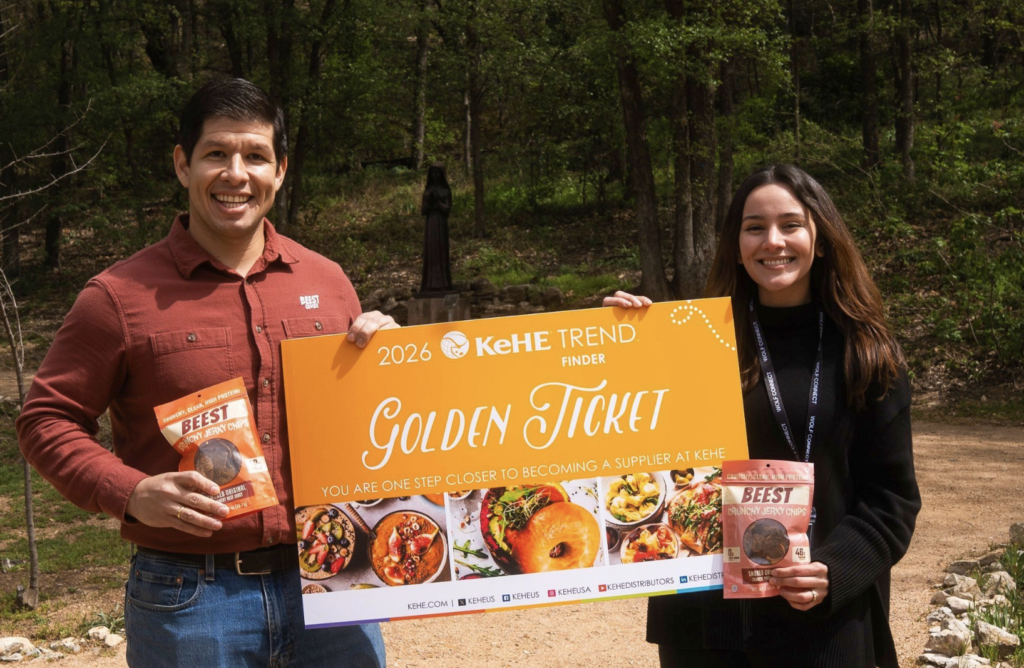
There’s a lot to love about the story of Nicole Ruiz and Lucas Prado, founders of BEEST Snacks.
There’s a wild amount of hustle – from surreptitiously turning his mom’s living room into a food processing plant while she was on vacation, to packing up their entire life and business to move from Bolivia to the US.
There are also awards – they recently beat ~90k other brands to hit RangeMe’s Top 50 – and a showman’s talent for marketing (case in point: they’ve literally tested the snap of their chips with a sound meter to prove they’re crispier than competitors).
There is protein (46g to 52g per pack).
But I think my favorite thing is that Lucas is the first founder ever to re-organize the questions I sent him, and move the one about his marriage to the very top.
If you’ve read a lot of these pieces, you know I always ask whether a founder’s married and how that relationship has affected their business (typically the second-to-last question, after the interviewee has warmed up a bit).
Answering is optional, but I ask the question for a couple reasons:
First, I’m a single guy. So you could say I’m collecting field notes as I hunt for my own Mrs. Austin Business Review.
But second, and more important, the role of spouses is one that’s too often overlooked in business media.
Obviously, not all founders are married, and of the ones who are, not all are official co-founders in the way that Nicole and Lucas are. But the theme across these interviews is clear: whether they’re on the cap table or not, a founder’s spouse is their most important business partner.
It’s always nice to see when they insist on it like Lucas…
1. Are you married? If so, how’d you meet your spouse, and what role have they played in your entrepreneurial journey?
It’s Lucas writing. This one was not expected but, in our case, it might be the most important question on this list.
Nicole and I met at university. She attended my thesis presentation, which happened to be about industrializing a healthy snack production plant. We met a couple of times after that and by the third “date” we were already talking about our values, goals, fears and dreams. Serious conversations. What we wanted a family to look like, how we’d want our kids raised, what we expected from a partner and what was off-limits.
I finished university one semester ahead of her. I’d been dabbling with this snack “idea” and managed to convince Nicole to come aboard. We were set to be married a few months later and working together would give us time to get to know each other better, faster.

About half a year later we were getting married. Working and living together brought to light the good, the bad and the ugly. Especially when COVID hit soon after the wedding. Strict quarantines were in place for about a year, leaving us with just each other to interact with, while piling on the stress of trying to grow a business when disease, recession and chaos were wreaking havoc around us.
One day during that time, we walked in on my grandma to surprise her and she yelped and spilled a bag of chips on the floor. Chips she had hidden in her desk drawer because she has diabetes and shouldn’t be eating them. It was a hilarious moment, but it stuck with us both.
There was nothing out there for her.
If you’re craving chips, there were no real alternatives. No crunch, no satisfaction, nothing made from real food. That became a driving force behind what we are building. The potential of our product to be that alternative.
There also came a time when we hit our first big retailer and our only two production employees decided they wanted a piece of the “company,” figuring we were surely rolling in dough.
The “Company” being Nicole and me and we literally had to break our piggy banks to pay the bills.

They came in one day with an ultimatum: hand over a piece or they quit on the spot. Next day Nicole and I were processing about 400lbs of meat, finishing just in time to start distributing to our newly onboarded retail locations.
That experience gave us the chance to reevaluate our production process and implement huge efficiencies. It also meant we could take control of how scaling would play out.
Having started in a home kitchen the procedures and controls for a bigger scale were changing and this gave us the chance to take direct agency over them and establish a solid foundation. Which came in handy when we started working with comanufacturers here in the States, where we had to train their personnel, adapt the process and set SOPs.
It’s hard to say what role Nicole plays because she’s such an integral part of the whole that it’s impossible to define where one’s contribution ends and the other’s begins.
I do know for a fact that without her on board the business would’ve been dead in the water.
You’ll read more about my strengths and weaknesses in question 2, but for now, suffice it to say I am inclined to jump off one too many cliffs and celebrate rewards long before their time. And that’s even before we get to the decision to uproot from somewhere all our loved ones are and we’ve lived most of our lives, and move to a city where we know nobody, a city we decided was the right place based on research and a one-week visit.
That would just not have happened without her.

2. Okay, tell us about your business! What’s the backstory? And how did you get your first customer.
We’re Lucas and Nicole, founders, engineers, a couple on a mission to revolutionize high protein snacks using real food.
The backstory has changed names, countries, continents, products and product names. Reinvented many a time. The only things that remained constant are the founders and our unyielding focus on using real food.
Our company is called Best International Foods LLC because at first the brand was BIF, which in Spanish is pronounced “beef” and was a good wordplay but in English it didn’t quite play out.

I started selling brownies when I was about 12. My mom and I had moved back to Bolivia from Philadelphia and were living with my grandparents in a closed community with hundreds of families.
I had less pocket money than all my friends so I started doing the only thing I knew how to do that could generate income: Bake.
I’d been baking since I was 3 or 4 years old. I had a little wheelcart, packed it with brownies and cookies, and a couple months later had a clean $100 profit.
In local currency, that was a fortune. I was the richest kid on the block. Took all my friends to the community store and got everybody ice cream (celebrating a bit too soon and lavishly.)
At that time and in that culture it wasn’t a “man’s place” to bake. Grilling, acceptable. Cookies and pastries, strictly a female affair. Being 12 and susceptible to the “what might they say?” syndrome, I told everyone my mom baked them and I just sold them. Business-man-like.

That business went dormant when we moved to another city. In university I picked it up again, this time focused on healthy ingredients. Wholegrains, sugar alternatives, the works.
Because a lot had changed – several family members had been diagnosed with diabetes, and I’d struggled with being overweight in high school – I got serious about nutrition, started training for an Ironman, and became a health-nut. Which led me to pick up the baking business with a healthy take.
Through a series of events involving an internship at a bank, a waffle dough contract I landed by learning to make waffles overnight from a Google recipe, and selling healthy products to gyms and cafes, I eventually started developing a crunchy-ish meat snack. Nicole and I had gotten together at around this point and she joined the business.
The industrialization of that snack became my university thesis, which is really where the story of BEEST Snacks begins.
Our first version was a crunchy jerky in a plastic bag with a paper label and a hand sealer. I dropped a dozen at a crossfit gym on a Thursday. The owner said he didn’t think they’d sell over the weekend. I told him if they sell you pay me, if not you don’t. Not much lost for either of us. By Monday they were out of stock. I took another dozen Tuesday. Thursday, gone again.
Eventually we put a sticker on it. Then a proper design on the sticker. Then we landed our first big-ish account, a gas station chain with 7 locations. How I locked that in is a long story involving being admitted to a clinic, a midnight ATM run, and a pitch in the dead of night coming straight out of the clinic.
That early product was different from the version we eventually developed for the US market. After hundreds of iterations, we hit on a perfect chip-like crunch and set our eyes on the States. We filed a patent for it since both the process and the product are completely different from other meat snacks.
Ever since we got together, Nicole and I had dreams of growing beyond Bolivia. The first real opportunity was a distributor in Sao Paulo, but that would have required setting up a manufacturing plant from scratch. Before committing to that, we attended Natural Products Expo West in March 2023 with samples in our backpacks to test interest in the US. The feedback was unanimous: “How soon can you deliver? What’s the price?”
Meanwhile, back home, the bank where all our business funds were had declared bankruptcy. Everybody’s money was stuck. There was no way to pay our suppliers. The contrast between what was happening in the States and what was happening back there made the decision clear.

We researched cities. Several articles pointed to Austin, Texas, where 3 of the top 10 CPG startups of 2023 had started. We tried Dallas first because we had a friend there and a distant uncle’s business partner in the meat-packing industry. But we knew wherever we started the business would be where we had to live, and we did not like Dallas.
As soon as we arrived in Austin, from the first breath and look around at all the green and the friendly people, we knew. Went back to Bolivia, wrapped things up, and moved here on July 12, 2023, because we wanted to celebrate Nicole’s birthday with the family on the 9th.
Today we make Crunchy Jerky Chips. Beef and Pork, delivering 48 and 46g grams of protein, zero grams of sugar, and just 3 main ingredients: meat, lime juice and spices everyone has at home (we like to say our weirdest ingredient is paprika XD). We recently launched the one and only: Charcuterie Trail Mix: pork jerky chips, parmesan cheese crisps and roasted almonds. 52 grams of protein, zero grams of added sugar. A charcuterie board in a bag.
Unlike regular jerky processes that, when trying to make “crispy” jerky deliver a crisp first bite that turns chewy, our crunch is real. Decibels of difference, tested in an acoustic lab (each peak in the graph is a recorded snap.) They snap like a chip. That’s the whole point. Real food, but the experience of eating a chip.
Our first Austin client was Mañana Coffee, shoutout to Sophie Stout (and her husband who tried them because she’s vegetarian) for believing in us! We’re now in Wheatsville Co-op, Royal Blue Grocery, Parker & Scott, independents in California, and growing.
Earlier this year we won a KeHE competition: Trend Finder, winning the Golden Ticket, a fast-track to nationwide distribution. That was a big moment.

3. What’s one unconventional decision you made early in your business that you believe set you apart from competitors, and how do you think it shaped your trajectory?
Once we realized there was real demand for the meat snack, we needed a regulatory certification to get into retailers.
My mom was on a long work trip at the time, so I called and asked if we could “rearrange” some of the furniture on her ground floor.
Rearrange meaning pack everything out, empty the whole floor, and adapt it for meat processing: installing PVC strip curtains on the doors, painting workflow signals on the walls, sealing off a glass door, closing access to the upper floors.
Rearranging was an understatement.
This allowed us to go from idea in a plastic bag with a paper label to retailers in an extremely short time. No waiting for a commercial facility. No asking anyone’s permission except my mom’s.
It gave no room for competition to even catch a whiff of what was going on.
4. What’s one book most people have never even heard of that you think is worth reading. (DIG DEEP – we’re looking for the books you’ll never see on the NYT list)
-
Business-related: The Fish That Ate The Whale by Rich Cohen
-
In general: Musashi by Eiji Yoshikawa
5. What’s one belief about entrepreneurship you held when you started that you’ve completely abandoned, and what made you change your mind?
That if you plan enough, you won’t run into surprises.
I believed that if you put enough effort into strategizing and hedging, you’d be ready for whatever came your way. I held on to that for way longer than justified, hell I still have some hope buried very deep within me.
There’s no specific surprise that broke this all of a sudden, more like erosion through repetition.
Our biggest supermarket account changing payment terms from 30 days to 60 days without informing us until we went to pick up the check.
Removing 2000 lbs of meat from the freezer to thaw for next day’s production and seeing on the evening news that quarantine was in place as of that moment and nobody could leave their homes, i.e. our production workers wouldn’t make it to the plant so once again the founders had to step into production.
Planning to find and start operations with a co-manufacturer in 6 months to (worst case scenario) 1 year, to have it take over a year to find the right comanufacturer and another year to get USDA approval that was slow to come because the process was so different than what they were familiar with.
Planning for exponential growth with our long awaited Crunchy Jerky shreds, to a lukewarm reception because, although people liked the taste and texture, it was just too unfamiliar. And planning their “official launch” at an event where we were told there would be up to 25k people with buyers from major retailers but ended up being about 500 during the whole three days and most of them looking for furniture.
The belief I abandoned is that preparation prevents surprises. It doesn’t. Preparation gives you the ability to respond when the surprise hits, it you’re lucky XD.

6. What’s one purchase of less than $1,000 that’s made the biggest impact on your happiness, health, or wealth?
A $39.95 Adjustable Mandoline Slicer.
When we launched our Crunchy Jerky in the US in July 2025, the product was in shredded strands. People liked the taste and texture but it was just too different. Not familiar. Retailers didn’t love it either. The first person kind enough to give us honest, useful feedback was David, the manager at Wheatsville Co-op here in Austin. He managed to sum up the whole problem in one word: “Confusing.”
Instead of pushing back or insisting, we went back to the process. Before we take anything to our comanufacturer it must be a functioning procedure with times, temperatures, HACCP, everything mapped out. We don’t have all the equipment to do a full batch ourselves, but since we know the production inside and out, we know how to simulate one in the kitchen and translate what works into a production setting.
That mandoline slicer was the tool that let us start down the road towards Jerky Chips, changing everything. We ran trials and figured out how it would translate into the production. Then we took it to the plant.

We relaunched as Crunchy Jerky Chips in January 2026. The same retailers who didn’t want the shredded version started picking us up. Wheatsville was first on our list. David saw the new format, and one week later we were on the shelf. That $39.95 purchase changed the trajectory of the whole company.
7. If you were to recommend one under-the-radar Austin spot to another founder for brainstorming or unwinding, where would it be and why?
Barton Springs pool. Before 8am. It’s free. You start off the day exerting a huge mental effort to jump into the cold water, swim yourself tired, get out feeling like the most disciplined human alive, and then set up your towel in the shade and think about whatever’s challenging you. Take a journal or your phone to jot down what comes to mind.
